Showing posts with label animation. Show all posts

Mar 14, 2014

Women In Animation


This Saturday, March 15, I'm moderating a panel at the Walt Disney Family Museum where I'll be talking with Claire Keane, Lorelay Bove, and Brenda Chapman about their experiences in the animation business, and their lives as animation artists.

Last October the museum also asked if I would write an essay for their quarterly on the subject of women in animation, past and present, which follows here.


In the 1970s there was one must-have for every aspiring young animator's bookshelf: Christopher Finch's oversized, heavy and beautiful The Art of Walt Disney.  Illustrated books detailing the history of animation, and more specifically, the Disney Studio, were almost nonexistent at the time; and at over 400 pages the Finch book was something I pored over for hours. I'd already fixed on the idea of being an animator, seeing it as the perfect career to marry my love of drawing, film, and performance.  I considered animation to be "the illusion of life": turning lines on a page into characters that lived and breathed in an invented world of color, design and graphic imagination.

Every page of Finch's book was filled with story sketches, animator's roughs, background paintings, and photographs– not just of Walt Disney, but also of his artists working at their desks, drawing just as I did and looking not much older than I was. But they were working on such memorable films as Snow White, Pinocchio, and Bambi.  Decades before I was born they'd managed to achieve the gold standard: working at the greatest animation studio in the world on films whose influence would long outlive them.

The old images fascinated me and I wanted to know more about them. One was particularly striking.  It showed a young woman, Retta Scott, animating on Fantasia.  While far from being an expert in either social history or 1930s studio-hiring practices, I knew that a woman employed as an animator in those days was rare, and that this had been the case from the beginning. The form of cartooning which preceded and inspired animated cartoons and newspaper comic strips, also had many more men than women employed in the field, and this disparity carried over into the new medium of animated cartoons. With rare exceptions, cartooning/animation work became a "guy's thing," though the intended audience for the cartoons and comic strips was both male and female.

So, by the mid-1930s, it seemed that any woman with artistic talent or experience who applied to a studio for work in animation was limited to a career in the "ink and paint" department, doing the crucial but creatively stultifying tasks of tracing animators' drawings on celluloid and painting the underside. This was by necessity an assembly-line sort of job, and while the women who did it were rightfully proud of their skills, the work certainly didn't allow for individual expression.  But there was Retta Scott, engaged in what was a traditionally male job. She was an anomaly—a female animator!  I later learned that Scott had worked in the story department as well as in animation, and in fact, there had been other women assigned to the story and development departments, including Sylvia Moberly-Holland, Bianca Majolie, and most famously, Retta's friend Mary Blair, whose career and influence would extend further than many of her colleagues'.

In the 1930s and '40s, a confluence of talent, opportunity, timing and connections were required for a talented woman to land a creative job at Disney.  This was also true for the men but to a lesser degree. It's impossible to know how many women who aspired to be animation artists were actively discouraged from trying, but certainly some were, as evidenced by the Disney Studio's 1930s form letter sent in response to women inquiring about jobs as artists. It stated that "women do not do any of the creative work in connection with preparing the cartoons for the screen, as that work is performed entirely by young men." While clearly untrue when one considers the placement of the women previously mentioned, the letter nonetheless expressed the company's attitude towards the idea of women artists in general.

This was unfortunate since not only were women at the Studio making artistic contributions, their work was also having a positive impact on the history of animation. The work of Mary Blair, in particular, caused a transformation in the look of Disney animation, and the opportunity for her to create stunning art was due to the direct involvement of Walt Disney, whose appreciation of her unique style and sensibility was not hindered at all by her gender. But Blair was a stunning exception; for most women, the opportunities to achieve personal distinction in animation were simply not available. Had it been otherwise, it's anyone's guess who else might have made her mark as Blair was able to.

Throughout my working life I've been asked the question, "Why aren't there more women in animation?" and I've never had an answer. I can only speak for myself and explain why I do what I do—a story that differs little if at all from that told by my female and male colleagues.  But while the question still gets asked, things have changed more rapidly in recent years than ever before. As a student at Calarts in the late 1980s, I was in a class where the guys far outnumbered the girls, and for the first decade or so I was able to tick off the names of all the other females who were somehow involved in animation.

Now, there are so many women working in the field that I can't begin to keep track of them all– many working as I do in story, but also in visual development, animation, character design, and every other classification. Online blogs by aspiring female animation students are even more numerous, and from a cursory check, show ever-increasing sophistication and range in personal style and storytelling ability.  It's a wonderful state of affairs for my industry and for everyone who's involved with the art of animation, and it'll be fascinating to see what the future will look like when a picture of a woman creating animation will draw no special notice at all.


Feb 20, 2013

Adam and Dog: The ineffable beauty of drawn animation


Drawings of Dog by Minkyu Lee.
 
Drawing of Adam by Minkyu Lee.
 
in·ef·fa·ble
adjective
1. incapable of being expressed or described in words; inexpressible: ineffable joy.
 
One late night about eighteen months ago, my officemate and fellow story artist Justin Hunt walked in with an animation sequence under his arm. It was old-school 2D, immediately identifiable by the sandwich of paper and cardboard secured with extra-long rubber bands. Here was something novel! Surrounded by cintiqs and working on cg films in studios where prosaic objects like pencils and paper are barely in evidence, just seeing a sheaf of hand drawn animation produces plenty of thrills-and I hadn't even bugged him to flip it for me yet.  When he did, I became more and more interested; the drawings were lovely. Just based on that one short scene I wanted to see the whole thing, though I'd have to wait a while. And I wanted to know why and how it was being done.

It turned out that Justin was one of a small, tight-knit group of friends helping Minkyu Lee complete the animation for a short film he was writing, directing and storyboarding, and animating. And designing, and painting all the backgrounds.

I first wrote about Minkyu and his film "Adam and Dog" a year ago, just before it won an Annie award. It was in an earlier, slightly unfinished state at that time, but the elements that make it the wonderful film that it is were all solidly there. Now it's another year, and it's one of 2013's five nominees for the Academy Award for animated short.  It's a richly deserved nod, and as I'm one of the corny ones who actually believes the old canard that the real honor is simply in being nominated by one's peers(in this case, members of the animation branch of AMPAS), it's already a winner, as are the other 4 shorts in that category.  But this film is special to me; it pushes all my buttons, and I thought I'd have a go at explaining why. 
Adam, completely comfortable in his Eden. Drawing by Minkyu Lee.


It's not necessarily difficult to make drawings move, but it can be well-nigh impossible to make them real-to live, to breathe, to exist on their own terms in whatever world the filmmaker decides to present them. The Story of Adam and Dog is simple, and all the more powerful for being so: The Fall from the point of view of the first dog in Eden. Although, being a dog, he sees and understands nothing so much as the joy of finding and bestowing all his loyalty and love on the first human being he meets and bonds with(and eventually, it's hinted, the second one also).

What I've described has the potential for a charming story, and a sweet and clever short could have been made that was just that and nothing more. But-and here's the thing that's so difficult to describe as cogently as I'd like-in this case, this film has been crafted with every element contributing to a result that has the layered, emotional impact of the very best of any sort of animation, short form or long. Or any sort of film making, for that matter. What's called traditional character animation-that is, drawings and paintings in two dimensions-just aren't featured in this sort of style anymore, and by style I mean not just the lushness and soft, illustrative quality of its look, but the serious, thoughtful and truly unique pacing, the choices of shots, the editing. I think it was the pure film making that Minkyu employed that really bowled me over, beyond the visceral pleasure I took in seeing drawn characters inhabiting a believable world, living and breathing(the animation, by the way, includes not only Minkyu's work but also beautiful footage from James Baxter, Jen Hager, and Matt Williames, among others).


There's no dialogue, although there's plenty of sound-wind, rustling grass and trees, the shudder of various animals pounding through the forest or swimming through deep water. Dog wanders alone through Eden, acting in an immediately recognizable doggy manner: marking gigantic trees, play-hunting through tall grass, running and barking for the sheer fun of it-and none of this is played cute-at least, not by my lights; it's real and genuine. Dog's animation has no self-conscious posing, but neither is it "realistic" to the point of seeming merely copied from life. The dog goes day to day-or perhaps endless days, or an hour-alone, until he spies Adam-who sees him in almost the same moment. It's a more momentous exchange for dog than man, but eventually they become friends. The idyll of Eden can't last, however, and the dog must make a choice.

This is a micro story directed in macro fashion, made big without pretentious allusions or grandstanding. I can't remember when I've seen something done on this scale, in this form, fashioned with such wise taste apparent in every choice.  Even after repeated viewings I still tear up a bit, not because of a piece of lovely character animation-something I'm always a sucker for-but because everything that's going on-shot choice, length of shot, expression, color, perspective. movement-combines to produce that effect in me.

This is one of the things that I loved about animation when I determined to do it for a living; I mean specifically the sensitive, carefully calibrated story that is outside the mold one way or another. Or if done within a very commercial framework, manages to fire on all cylinders entertainment-wise while being a work of art at the same time, or, perhaps more realistically, having moments that satisfy on that level. This 15 minute short happens to be animated, but it employs an approach that at first viewing reminded me of Terence Malick (not surprising as it turns out, since Malick-along with Sofia Coppola, Tarkovsky and Godard-is one of many directors Lee admires), specifically the lyricism of "Days Of Heaven".


 And this is from a workaday visdev artist, on his own time, his own money(the budget is small by the standards of any short of this quality),with friends' help, To serve his own artistic vision. The result exhilarates, inspires and shames me in just about equal measure. I'm just very glad he made it.
 
 
I'll write a bit more with quotes from an email exchange between Minkyu and myself in another post. In the meantime, have a look at "Adam and Dog" if you can.  It's indeed an ineffable film.


Aug 14, 2012

Para-nimation

A model of the title character's house from "ParaNorman" on display at an Arclight theater.

There's a nice article about Laika in the New York Times today. While not tremendously in-depth, it's a neat bit of context for the release of the Portland studio's"ParaNorman" this Friday.
Moving Ahead in Stop Motion/With ‘ParaNorman,’ Laika Aims to Push Animation Boundaries

It's a wonderful and fairly astounding thing that not one but several studios are busy making animated features in this viscerally appealing, supposedly "throwback" technique.  At SIGGRAPH in 2008 Laika had a booth filled with puppets, sets and props from their then-unreleased "Coraline"; I could have stared at it all for hours, and the resulting film was a happy experience-different, moody, ambitious, and in many moments and respects very beautiful.

When I was launched on the Aardman/Dreamworks production "Flushed Away" in 2008 I went into the conference room to hear a pitch of the film and get my first assignment. Before they began the directors, David Bowers and Sam Fell, put a puppet of a character from "Chicken Run"-Fetcher the rat-into my hands. At that point it was going to be a stop motion, not CG, film. Looking at this little plasticine figure in his miniscule tatty clothes, charming, completely solid and three dimensional, was an inspiration; I just wanted to see him move-to act.
Artists have a tremendous soft spot for handmade things, don't we?

Jun 20, 2012

The New York Times on the design of Brave's Merida


Matt Nolte's early sketch of Elinor tangling with Merida's unruly mane. c. Disney/Pixar
On June 15th the New York Times ran a very nice piece dealing with the design development of Merida, the heroine of "Brave". See it here.

And not only see, but hear: as is often done at the Times, there's an accompanying slide show of artwork with narration by production dsigner Steve Pilcher and directors Brenda Chapman and Mark Andrews.

I've been looking forward to seeing the finished film for some time, and will finally get my chance this Friday. I saw it three times (most recently in March of 2011), but it's existed for me mainly as the preproduction work and vibrant thoughts of its artists-the material for my book, "The Art of Brave". Tomorrow I'll post a little about writing it.

Mar 14, 2012

Trailer: "Longway North", aka "Tout en Haut du Monde"

At lunch today with several of my story colleagues the talk turned to films as yet unreleased, those in different styles and with potential we find exciting and inspiring-in other words, the usual banter. Johane Mate mentioned a trailer she'd seen for an upcoming French feature that really engaged her. It sounded like something I had to have a look at. Having just done so I think you should, too. Its english title is "Longway North":

Pilote Tout en Haut du Monde / Longway North from Sacrebleu Productions on Vimeo.


I just love the look of this. The director is Rémi Chayé.  Disney story artist extraordinare Paul Briggs points out that there's a production blog here. While I was turned onto this today, he had it up last night. Indefatigable Briggs! Be sure & visit his blog.

Dec 13, 2011

A Merry Christmas from Disney's in 1955

 This is a repost of one of my earliest entries, shortly after I began this blog in 2005. I think it suits the season and so merits an encore.


This is the front of the Disney Studio's 1955 Christmas card.  It's quite a beautifully done thing; printed on a soft, high-quality paper, it's a large card that opens into a double-spread of the brand-spanking-new Disneyland, with a calendar running down the sides.  I was unable to scan the entire thing, as it's just a bit longer than my scanner is.  Great artwork--I don't know whose...anyone have any ideas?


May your fifty-years-on New Year be merry and bright!

Dec 8, 2011

Bravery

Although it won't be on shelves for another seven months, last week Amazon put up the cover art and a short description for "The Art Of Brave", which I had the pleasure of authoring. It's going to be quite a beautiful book, one that I only wish could have been twice as long as its 160 pages. I'll write more about it here as publication time draws nearer.

In other Brave-related news, Brenda Chapman began using Twitter and has started a Tumblr blog. There's not much there yet as she only just began it, but it does link to a new, very good two-part interview with Brenda on the site Pixar Portal. Her thoughts on art, work and storytelling are a must-read.

Oct 17, 2010

Imagination+animation+technology= a profoundly jaw-dropping filmic experience

I was emailed about this yesterday(thanks, Joe and David Doherty), and it's something I thought the passersby here would definitely appreciate. The link comes from a site called Kotaku, and as they wrote, in "a technique called video mapping, the Macula project takes the 600-year-old Astronomical Clock on Old Town Square in Prague and transforms it into one of the most impressive things we've ever seen. See for yourself."

The 600 Years from the macula on Vimeo.


Quoting from the Makula website (translated from Czech):

Video mapping using current technology available in the entertainment industry, a whole new way. The main contents are the projections to cooperate with the selected object and try to break the perception perspective of the viewer. With the projector can fold and stress any shape, line or space. Evocative play of light on the physical object creates a new dimension and changing the view of the seemingly "normal thing". Everything becomes an illusion.

I think this is pretty cool stuff.

Aug 4, 2010

Great Inspiration: music-only soundtrack for Lampwick's transformation in "Pinocchio".

I just found this on the blog written by Jaime Weinman, Something Old, Nothing New-which he in turn found on youtube. It's arguably the most frightening scene in animation history-Pinocchio witnessing the wages of childhood sin on his new friend Lampwick.
Everyone's seen it numerous times, but here it is presented with no dialogue or other track-nothing save the dramatic score of composer Leigh Harline. The character animation is primarily the work of Fred Moore, Ollie Johnston, Milt Neil, Milt Kahl and Eric Larson.


I can't remember how I initially found Weinman's blog (and in all honesty I don't check in with him often enough these days), but in my internet wanderings he's one of the best writers on film and other popular entertainment I've come across. His entries are frequently so fascinating that I'll become interested in a title I either had no patience for or any curiosity about before he examined it. That's obviously not the case with "Pinocchio", a film I probably put at the top of my animation mountain, but it figures it's Jaime who shares something that's a must-see for anyone who loves animation. Be sure to read his accompanying comments about composer Harline.

Jul 12, 2010

What's up with Bird (Brad)


Robert, Brad and George at ShoWest in 2005
Because it's always interesting to hear what's going on with him and because his name probably gets mentioned by someone in our industry 83.2 times a day in some context or other, I was very happy to read this exclusive by Nikki Finke at the head of her Deadline Hollywood blog tonight:

From Deadline.com/Hollywood by Nikki Finke: I hear that, after a hot pursuit by all the major Hollywood agencies, formerly rep-less Brad Bird has signed with UTA's Tracey Jacobs and David Kramer. The writer-director is currently prepping to helm Paramount's Mission: Impossible IV for producer J.J. Abrams, with Tom Cruise starring. But Deadline has reported previously that Paramount is currently rethinking MI4. I hear the script that came in is very good, but the studio is still trying to figure out the budget as well as Cruise's role in light of the lackluster Knight And Day grosses. There's talk that Tom's character will mentor a young operative this time out if the pic proceeds. I just hope Bird is pay or play.

He's also attached to direct 1906 for Warner Bros. Bird won two Academy Awards for directing the Pixar hits The Incredibles and Ratatouille, both of which he also wrote. Bird's first major animated feature came with Warner Bros' The Iron Giant, which he wrote and directed. In addition to working at Pixar, Bird has also had a prolific television career, having worked on shows such as The Simpsons, King Of The Hill, and The Critic. Bird will continue to be represented by attorney Jake Bloom.


Any news such as this is good news. Everyone I know wants to see whatever he does next as soon as may be.

Jan 10, 2010

Gainsbourgia, and French Roasted Animation

Serge Gainsbourg - animation des graffitis sur 5 ans du mur rue de Verneuil from Arnaud Jourdain on Vimeo.


I saw this posted on animator Matt Jones' Facebook page and felt compelled to share it.

The backstory-all of it that I think I know-is that since the death in 1991 of the legendary French singer-songwriter and world class roué, Serge Gainsbourg, the walls of his home on rue de Verneuil in Paris have been used by fans as an ever-changing palette to express their love and regard for this epic character. Seeing the various scrawlings, pictures and messages, put to Gainsbourg's music and literally parsed as they are in the clever film process used is not only hypnotic but for me quite moving.

Apparently (difficult for me to make out as I don't read french) there's a film in production that is making some use of this graffiti via animation done by a studio named Zebulle. And at the end of the piece appear some great drawings by an artist named Joann Sfar, who's making a film on Gainsbourg which is incorporating the Zebulle animation...I think.
I've seen his book "The Rabbi's Cat", but unfortunately don't own a copy of any of his work-which makes me think I'd better place an order at Stuart Ng's when my piggy bank is replenished. I think a post about bande dessinée and french animation is called for at any rate.


And speaking of the fair nation of France, yesterday I was at a screening of the Academy of Motion Picture Arts and Science's short listed animation nominees, among which was a really wonderful short written and directed by the veteran, ex-Dreamworks animator Fabrice Joubert, "French Roast".


This captivating film has fantastic atmosphere, staging and character animation-in its lead character in particular. While watching it I wondered, "Didn't Bibo have something to do with this?" and sure enough, he produced it. Another familiar name designed it: Nico Marlet. And yet another: one credit goes to the charming and wonderfully talented animator and illustrator Aurélie Blard-Quintard; a visit to her blog is a must.


Illustration by Aurélie Blard-Quintard, from her blog "tea-time, isn't it"?

I just love this short. Here's a link to watch it all.
And here's more good stuff about how Nico's designs were translated to the screen (one of the best 2D to CG translations I've seen) from the French Roast production blog.
Amusez-vous bien!

Nov 6, 2009

Richard Williams' A Christmas Carol

This youtube posting is not of the very best quality to say the least, but I was reminded of this special yesterday and the impact it made upon me when I first saw it-old Magnavox, living room floor, Hancock Park, the 70s. One viewing cemented Richard Williams for me as someone working among animation's elite, although if I remember correctly he got a lot more press later for his "Return of the Pink Panther" titles.
But this TV special was just wild. It still is--even in these few clips, just the layout alone...amazing. And while I'd put the Ghost of Christmas Past in the Alastair Sim version a close second, the way it's done here is the most faithful to Dickens' description--a great marriage of film, drawing and concept realized together. And Marley still shocks me.


Sep 24, 2009

A Disney Dream realized: The Walt Disney Family Museum is about to open


Interior of one of the galleries of the Museum. Photographed by and used with the permission of David Lytle.


Last year out of the blue I received an email asking about one of the photographs I've featured on my blog. This happens fairly often, but this time the source knocked me for a loop: it was the people who were amassing exhibits for the long-awaited Walt Disney Museum underway up in San Francisco, in the stunningly beautiful Presidio. Would I be amenable to helping? Is Fred Moore my favorite good girl artist? Is the Blackwing a pencil?


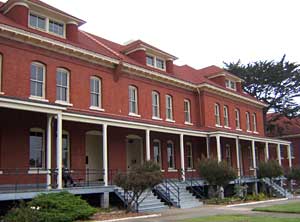
The circa 1890 barracks at San Francisco's Presidio. They had to be very carefully modified and worked around by the Disney Museum's architect to meet the requirements of this historic site

Of course I was happy to be able to help out in any way however small. When dropping my original off I was privileged to be shown an elaborate virtual walkthrough, examples of exhibits, and an overall idea of what the museum would be and look like. I found it utterly exhilarating. Truly worthy of Disney's oft-expressed vision of educating coupled with appeal and fun, it's clearly been based on his own approaches to those goals.

The cover to a Museum book that will be available at its bookstore in October. In addition to the store, there's also a theater, a cafe and an education center as part of the campus.

I won't see it myself until tomorrow at a preview, but if it's anything like the plans it's going to be a standard for this sort of place. Walt Disney's life and career contained experiences so simultaneously relatable and visionary, combining spectacular success with equally numbing failures (from which he managed to recover despite sometimes terrible odds--a point the Museum intends to make clear as part of its presentation) that he easily deserves a permanent educational resource of this kind. It's one his family, in particular his daughter Diane Disney Miller, have worked tirelessly to make happen. It's a shame that it's not located in Los Angeles, but having lived in that city for most of my life I can't say I'm amazed that the project couldn't be realized here. And it does make an excellent excuse to make more trips to the Bay Area if anyone needed one.

Opening day is almost here: October 1st. The Museum has been sending me various materials from its holdings and (I'd imagine) displays, a few of which are illustrated here.

Walt and Diane in Los Feliz in the 30s, a stone's throw from the Hyperion studio

Regardless of Walt's telegram, you just know Roy worried.

Yet another rare piece of visual development from a woman Walt gave a unique opportunity to: Mary Blair


Funny--it doesn't say "Park" anywhere on this billboard

It wasn't all work and no play: Walt learned to ride as my own father did-on a midwestern farm. Years later he used this saddle where I've ridden today: the Santa Ynez Valley. Don't know why the color swatches are there.


I wish I knew who drew this board for "Mary Poppins" so I could attribute it-anyone? Note the aspect ratio

After Friday I'll post my impressions; in the meantime, I'd think that regular readers of this blog--assuming you're still around--will have to start planning that little jaunt to San Francisco now.


The Walt Disney Family Museum
104 Montgomery Street
The Presidio of San Francisco
San Francisco, CA 94129

T 415 345 6800


Aug 4, 2009

Animtip Tuesday: Tweeting Animation Tips


For people who use Twitter, this is of interest: today a lot of animation artists who use the keep-it-extra-short internet communication thing Twitter are tweeting tips--tagging them all with the hashtag #animtip. If you tweet have a peek.

I stumbled on this thanks to Clay Kaytis, owner/operator of The Animation Podcast and Animation Supervisor of Disney's eagerly awaited feature, "Rapunzel" in his day job.

EDITED TO ADDIf you work in or study animation, tweet and have a helpful tip please dive on in and contribute.

Jun 27, 2009

In My Beautiful Balloon...


I tend to avoid standard reviewing of contemporary animated films. In the first place there's plenty of that everywhere else. And more importantly I feel close enough to even those films and studios I personally have nothing to do with that I'm sure my reactions are skewed one way or another. There's aren't degrees of separation, plural, in the animation business. We're virtually all connected with every kind of tie and association, sometimes unwittingly. So it can get complicated. In any case I thought I'd post some random thoughts I had while watching "Up" in 3D a week after its opening:

I was struck by how beautiful I found the palette and textures to be. It looked painterly, roughly so in places, as with the side of a palette knife. There was a particularly delicate use of lighting in what seemed a great collaboration of the visdev(AD) and CG departments. It made such an impression on me that I I broke one of my cardinal rules and elbowed the person next to me, forcing him to lean in so I could hiss "I can't believe how great that lighting is!" and "Would you look at that fireplace!" in their ear. What you wish for as a toiler and as an audience member is that the story and visual beauty will both take you out of yourself and put you in that world, and I thought the entire opening succeeded brilliantly with it. I may sound as if I'm contradicting myself there, but it was a beat after being impacted by the beauty of the shot that I woke up to the extraordinary aspect of it. Eating one's cake and seeing it, too. The sets looked to me for all the world like a cozy Viewmaster setting from the early 60s, which I delighted in throughout.


I admired (as so many did) the storyboarding, particularly the "growing older together" montage early on. I reckoned it was done by head of story Ronnie del Carmen, and someone told me I was right.
There are a lot of ways to board anything, never one right way (the filmmakers hope it seems the only way), but the way that was done--the transitions, cuts, all the choices--were perfect. I arrived at that verdict because I felt exhilarated watching it. It had to be a tightrope walk to avoid slipping into bathos (some critics felt it did slip, but only a few; to achieve that is a feat with this material).

I felt as touched by the sweet comedy relief of Dug the dog as I did at Carl's running struggle with loss. That might seem a pretty odd thing to say-and I allude here with a virtual smile to my respected friend who may think I've regressed to an eight-year-old's perspective to claim it-but there it is.

"Dug" was a win for me because of this: one of my pet peeves is the lack of films that make use of plain old reality for comedy, for pathos, for appeal. Dug was in appearance a wildly caricatured canine, but his actions, movement and the clever way his thoughts were translated into dialogue were more real than real for any dog lovers in the audience--and judging from my audience there were a lot of us. The kids squeal and love him because he's friendly-looking, and funny. The adults laugh and respond because they consciously recognize Dogs They Have Known in this unlikely character--and here, by the way, is an illustration of the work methods of the filmmakers I was blogging about in an earlier post. I don't know which of those involved drove the character's handling-director, story people, producers,animators or as is likely a melange of all of them. But those people know dogs, and moreover have loved dogs--a special dog. And have a healthy amount of empathy and imagination and skill enough to make their experience translate to the screen. This is why I enjoyed Dug so much, and not because I'm wallowing in my childhood.

And this gives me an opportunity to say how really fine I thought the character animation was in "Up". I don't know who you are, but I want to find out-all of you: the crews who did Carl (young Carl and Ellie in particular-superb), Dug, Muntz, "Kevin"...all these characters had scenes where the movement and performance blended together in an idiosyncratic and beautiful way. It's a new high point for you guys-as every new film should be, ideally.

There were issues that I found myself thinking about while the film was running, things that I didn't understand, or that I would have done differently. It's a habitual story habit thing--an occupational hazard of the business. I could go into them but I won't, not even obliquely. Not because they're so harsh that I'm afraid to offend but because--on my blog or off--I'm wary of being taken out of context and let's face it, it does happen. It's all too easy to misread a written sentence. It's too black and white, and where some things are concerned my opinions and reactions are more fluid than that. I'm much more comfortable discussing anything I take issue with in person, where a conversation can be had rather than a one-sided speech made. And I'm not a professional critic besides.

An old man in a flying house heading for South America is not your everyday plot. Add a lot of visual beauty and some sincere heart and I want to see it. More than once.

Jun 11, 2009

Pix[ar] is [not just] for kids.


"If you want to make a movie for children then make a movie for children. The experience for a parent or guardian is that they are spending time with their children at their child's level. The movie is not meant to satisfy an adult in the audience. You do not have to consider adults when creating content or story lines for "childrens" movies. Far to often mature content is blended into scripts only to promote the feature as "something for all to see". The marketing of this movie was selfishly aimed at drawing young children to the theatre. You call it "PG" but then you market it for a younger audience. Creating many 6, 7, 8 ,9 and 10 yr old Birthday parties/gatherings when this content is way too deep for them to handle and or enjoy. Pixar...Step back and really think about what you product is saying and who will be watching and effected by it. Two thumbs down from Daughter and Dad."
— ke flannigan, boston

-from the New York Times readers' responses to Manohla Dargis' review of "Up"

I finally saw "Up" last weekend, and I mean to write some of my first impressions in a future post. I'd avoided most of the reviews, wanting to see the film with as little baggage as possible, so I had to go back to see what was said about it including its review in the New York Times. Ms. Dargis' take was mostly positive, I think-albeit with some slightly schizophrenic and vague caveats. Her piece seemed possibly edited down.

What really caught my eye was the "Reader's Review" that I quoted above--a comment posted underneath the online version of Ms. Dargis' review. I thought it would be a good springboard for writing a bit about "Up" in particular and all animated films more generally.

So about the comment of "ke": what he writes is simply wrong.

Now, I'm of the opinion that very few if any reactions to a film are ever wrong. How could they be? All artistic experiences are subjective; one person's honest impression is as valid as another's, really, as far as it goes.

Obviously there are plenty of riders on that subjectivity: one person simply might have what I'd call better taste (more subjectivity at work there): they might be more educated about films, more experienced in life, awake, more receptive, generally appreciative of art and/or craftsmanship in all its forms(this can lead to a negative as well as a positive reaction, by the way). Another might have life experiences that drastically affect his or her judgement of a film, whether it's "The Sorrow and the Pity" they're watching or "Duck Soup".

All this might seem obvious, but I've read reviews from professionals that I admire-Andrew Sarris, Pauline Kael, et al-where once in a while they seem-to me at least-to be oblivious to some pretty extreme personal biases. But the bottom line whether professional or paying audience member is that each is entitled to their own opinion--it's the nature of the art.

In the comment above "ke" is taking another tack entirely. He's dead certain that the filmmakers of "Up" have made a cardinal error by misunderstanding who their audience is--children. He's actually dead wrong. Because children as some separate group are not who the film was made for. Certainly it was hoped they'd be part of the audience. Absolutely the reactions of children mattered to the crew, whether they happen to be parents themselves or not.
But so do the reactions of the dads in the audience--and the moms, teenagers, older people, and any other permutation. All of them make up the imagined audience. Yet even then, without forgetting or dismissing them, they aren't who the films are made for, it's who they are shown to--hopefully with the result of entertainment.

I'm going out on a bit of a limb here because I don't work at Pixar, I haven't spoken to the people who worked on this about it, and to date I haven't read any interviews specifically about its production. But I'm still sure I'm right.

"Up" was made for the same people it was made by. That isn't accusing the artists of solipsism-the inability to look beyond one's nose. It's about telling a story with a with a personal meaning, a personal intent. When you start with that, you-and eventually your coworkers-are the litmus test for whether your idea communicates. You know what you want to do, and then you proceed to do your best--everyone pitching in--to accomplish it.

Contrary to some reports Pixar's method isn't really a special secret, magic trick or rocket science. It also isn't easy. I'm sure sometimes it doesn't turn out films exactly as originally imagined. But it stems from individual imaginations: someone with an idea they're totally committed to doing. Other artists are brought on immediately to work on it if it's a go; they too put their stamp, their spin, their characters and their ideas into the mix. The film story usually begins to change, veering one way, then the other. There are peaks and valleys aplenty in the long years of production. There always are. I haven't read of any animated feature production anywhere that was entirely smooth sailing in the story process (well, maybe "Gulliver's Travels" at Fleischer's in 1938-enough said). So with all that work involved over a period of years, there has to be, hopefully, someone at the helm who knows what they want and why it should be there. To say a film is aimed "at children' is too vague, broad and vast a goal. But to please the child, young adult and grownup that the director has inside him or her is not only doable, it's imperative. Certainly the head of a production seeks out other eyes and ears and opinions, but the buck has to to stop somewhere and someone needs to know what the point of it all is.

It's long been a monkey on the backs of both animation lovers and professionals that "cartoons" have been so firmly fixed in many people's minds as primarily directed at children--often, small children. With every non-kid animation watershed in our generation--Roger Rabbit, Ren & Stimpy, The Simpsons, Beauty and the Beast, Shrek, anything produced by Tim Burton, anything written and directed by Brad Bird--it's been hoped that the old cliches about "animation is really the domain of wee ones" would finally be busted wide open--or at least dropped by the critics who really should know better by now.

But weirdly, with all those successes and very un-totlike films' releases--even with a studio or two whose entire output is well-known and successful for more adult oriented comedies--it still hasn't happened, and each time a film is released there are always too many writers who scratch their heads about why on earth something not specifically focused on preschoolers found its way into an animated film.

They forgot, if they ever knew, that even the very first, most famous commercial animated feature had adult thrills, action, and moments of beauty that were aimed at everyone: the grand premiere of "Snow White" had virtually no children present at all (exceptions being perhaps Shirley Temple, or Wallace Beery or Eddie Cantor taking a daughter). No, the stamping, shrieking, laughing and applauding audience was made up of all of the adult producers, directors and actors of Hollywood--everyone from Zanuck to Dietrich. A film made by adults, for adults-and for everyone else who could enjoy it, whatever their age. Why has this been so completely forgotten? Why is it a forgetting that recurs over and over again?

The agenda or template "ke" thinks Pixar should be following is a harrowing one. I've read enough to know that not everyone in animation fandom is pleased with "Up", but I can't believe that anyone, no matter what their take, would believe the answer is Pixar gearing their features for small children.

Why is this father so annoyed that the filmmakers of "Up"--a fable about an elderly man at the end of his life that includes a little boy but has much more, plainly, to do with the elderly man--didn't aim it at a "child's level" in any case? Which world does his daughter live in? Does it have old people and adults in it? Has his little girl ever felt sorry for someone(or herself), or had any sort of loss--even if it was only, say, a balloon she let go of? Does she like to play pretend? Does she like animals and stories?

If the answer to any of those questions is "yes" than she's got a lot in common with the filmmakers, and she's just as much a part of the potential audience as "ke".

Or "jl" for that matter.


May 18, 2009

Ricky, Pete, George Booth and UP


sketch of Carl by Pete Docter

Yesterday's New York Times had an interesting article about the character designs in "UP".

Read it here.

Accompanying the text of the original published piece is yet another of those online-only great Times interactive specialties, with Ricky(Nierva) and Pete (Docter) discussing their ideas. Wonderful stuff.

And if you're not familiar with George Booth yet, you should be.

ADDENDUM: Some of you probably know that "UP" had its premiere at Cannes last week. I know virtually nothing about the film. First, because in its early days as with all the projects of that studio no one working on it or around it said anything, and so pretty much everyone not in Emeryville was in the dark.

When we down south do get jots of information--that Brad Bird has taken over direction of "Ratatouille", for instance--all we know is it's something concerning a rat/chef. Dubious as it might seem as a premise, it's usually a safe bet to assume that Bird will pull off whatever he's doing.

The same goes for the people working on "UP". While I've certainly been curious about it, as its release nears I find I don't want any spoilers at all. I really want to be surprised.

So, the film finally opened at Cannes--the first film screened (out of competition), a gala event. It was reported that it received an ovation. Todd McCarthy, longtime primary reviewer for variety and one of my favorite writers on fllm, filed his report. I skimmed the traditional bold-type opening paragraph, reading no further than that as I didn't want to learn anything crucial. Here's a bit of what he wrote:
Tale of an unlikely journey to uncharted geographic and emotional territory by an old codger and a young explorer could easily have been cloying, but instead proves disarming in its deep reserves of narrative imagination and surprise, as well as its poignant thematic balance of dreams deferred and dreams fulfilled.

Mr. McCarthy doesn't toss around that kind of sentiment very lightly.
It sounds lovely, and I wish the crew all the happiness that a good film will bring, that they've earned through their hard work these last 3-plus years.

Feb 26, 2009

iPhone App'imation: Randy Cartwright writes an Animation timing app for Apple.

Randy Cartwright: animator, story guy, committed iPhone geek. My kind of fellow. With a self-taught ability to program, this veteran Disney artist has created a neat little application for lucky owners of Apple iPhones and Touchs: an animation timing program called(aptly enough) Animation Timer.


Randy taps the Timer

It wasn't long ago that Randy told me he had this idea to write his own program for the iPhone, something that would be eminently useful and that no one else had yet done. As there are already a gazillion apps of all kinds for the thing, that would be an admirable feat. A very short time later, he'd done it and voila! It lives. Simple to use and at $2.99 a lot less than the old Minerva stopwatch Cartoon Colour used to sell.

Randy's official App store statement(reiterated on his app website) is as follows:
"Animators can use a stopwatch to time out actions but there has always been an annoying problem. Stopwatches show time as 1/100ths per second but movie film runs at 24 frames per second. To find out how many frames you need to do a tiresome calculation containing 41.66667 each time. I’ve always wanted a stopwatch that would show the time in exactly the format I need so I decided, what the hey, I might as well make one{...}."
The stopwatch action starts with either shaking the phone or tapping the screen. Each additional tap marks the time, which can be shown in either film footage, film frames, NTSC video frames or PAL video frames, as well as in seconds.

If you're interested, all you need to do is search for "Animation Timer" in the iTunes App store. And you don't need the iPhone to use it--it works with the iPod Touch. Very cool.
Enjoy!

The man and his program

Feb 10, 2009

Shane P. and Shannon T. and Coraline J.


Shane Prigmore and Shannon Tindle are swell guys: friendly, generous with thoughts and props, and fun. They also draw and design like a bat out of heck.
At top is an example of Shane's work; Shannon's is below; click to enlarge them(and there's much more where they came from-see the links below to their blogs).

Dreamworks has them right now, but several years ago they were working on a stop-motion feature based on an exceptional book by Neil Gaiman, my new favorite author(be sure to read his latest, "The Graveyard Book", which just won the Newbery medal as the outstanding children's book of the year-also keeping in mind that in my opinion Gaiman, like all great authors, doesn't write so much for children as for himself).


I went to see "Coraline" on Sunday. It's a film that both men gave a lot to, along with many other brilliant artists.
I should probably do a separate post just about the film, but for now here's a sampling of some beautiful work Shane is sharing on his own blog, and Shannon's equally inspiring paintings are here. Go see--there's a lot more and it's all simply wonderful.

Lastly, here's a link to what's far and away the best of the several Coraline trailers, on YouTube. Really worth watching, even if you've seen the others.

Nov 6, 2008

This 'n' That


Retta Scott at her animation desk at Disney's


Where did October go?

The fall months are busy ones, but this blog needs updating. Several things in the works but for today--please make sure you visit Michael Sporn, the better to enjoy his latest posts of artwork from "Toot, Whistle, Plunk and Boom". What's old is new again, always; these images are fantastic and inspiring.