Showing posts with label story. Show all posts

Mar 6, 2012

On Story: No reason to sacrifice character to plot

This is a reposting of a Diaries entry from March 2006 that I think bears revisiting.

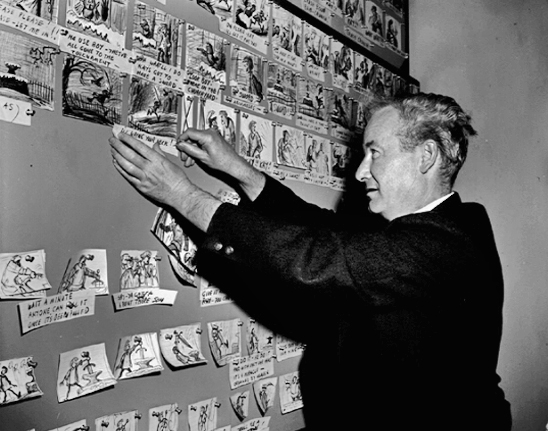
Michael Sporn posted this still of Bill Peet-taken from the Sword in the Stone DVD-on his blog in 2008

Michael Barrier makes some sharp--and challenging--comments about the point of great character animation in his most recent post. He describes his friend, animator Milt Gray, flipping some of Ollie Johnston's animation of "Jock" from Lady and the Tramp, and being startled by the amazingly lifelike performance that sprung off the pages. Barrier continues:

The great virtue of Disney films like Lady and the Tramp was that they showed that such animation is possible. Their great vice was that they seemed to say, in a louder voice over time, that such animation is possible only in children's films.
As a result, the temptation, if you're making more "adult" films, is surely to shrug off the Disney animators' lessons; but there's no way, if you're doing that, to achieve the emotional strength of their best work. A lot of animated filmmakers seem to think that they can work around that problem by making "story" their mantra, or by simply ignoring the question of how to give animated characters a vivid presence on the screen. But such dodges never succeed. It's only by meeting head-on the challenge of making the characters in their films as real as the best live actors that animated filmmakers will ever escape from the ghetto to which they have been, so far, rightly assigned.

Tough words...but I know what he's talking about, and I suspect most of my colleagues do, too.

To turn Barrier's premise inside-out, though, there have been some Disney films where "story" took a backseat to characters. In that category I'd put "Sword in the Stone" and "Jungle Book", both films I saw and loved as a kid and still love--but mainly for the performances of such as Shere Khan, Archimedes, Merlin and King Louis--not for the relatively weak story/plot and the corniest gags that are in them. Were the characters in those films not as entertaining and real as they are, there'd be pretty much nothing there but color and movement.

It's been said by wiser heads than mine that in the latter days of the nine old men, they were actors without a worthy stage, much like Laurence Olivier giving it his all in "Boys From Brazil" or "The Betsy". Feature animation was in a general doldrums; the kidvid ghetto was going full bore on TV, and there was no guiding hand at the world's most sophisticated animation company. It seemed to operate on the inertia of a more energetic time.

I think there are definitely pitfalls in having a story "mantra" that ignores just who's doing what in a film, though it's never intentional to sacrifice personality for plot--the aim is almost always the opposite, in fact.

Maybe there's a perception among non-artists of animation as having some sort of special needs, since our characters aren't seen in early development as castable flesh and blood actors, but are drawings and designs.

Of course the very, very early, embryonic beginnings of a feature film are a story's premise. If there isn't any story there to tell, well, that's trouble. It needn't be at as big as an epic, it can be small and even personal--but in the end it has to connect with a wide audience, and more than plot it's characters who carry that burden.

So to continue and develop that premise, assuming the story has something to work with it really does depend on the characters(that goes for the great shorts as well: Bugs Bunny trapped on a desert island is a hell of lot more interesting than Barney Bear trapped on a desert island or a Genericized Rabbit in that situation).

The story of a father fish looking for his lost son...okay. The story of a terribly neurotic, xenophobic, keep-to-the-reef father fish forced to plunge into deep seas, teamed up with various creatures he'd never want to deal with, but does it anyway, struggling all the while? Much better.

One doesn't want the plot running the characters, one wants the characters to be the plot--to make it their own one of a kind story, if you will. But(remembering "Sword in the Stone")they still need something worthwhile to do, and in a long-form story it probably can't be a one-set premise(never say never, but to generalize). No "Waiting For Godot"s. Pinocchio should get out of Gepetto's workshop. But personally I don't see any way forward in any story without nailing down the characters first. I have to know this person if I'm going to make drawings of them, and especially if I have to have them do or say anything.

Ideas come from drawing; good drawings--great drawings--come out of acting, the old "acting with a pencil" canard. It's really true. The more you know and love the characters, the more options for entertainment you'll have. They'll take over a scene in the same way novelists describe, with their characters. If you're taken in an entirely new direction, and it's going to work, it might be a very good thing when strong characters hijack you.


Oct 17, 2010

Imagination+animation+technology= a profoundly jaw-dropping filmic experience

I was emailed about this yesterday(thanks, Joe and David Doherty), and it's something I thought the passersby here would definitely appreciate. The link comes from a site called Kotaku, and as they wrote, in "a technique called video mapping, the Macula project takes the 600-year-old Astronomical Clock on Old Town Square in Prague and transforms it into one of the most impressive things we've ever seen. See for yourself."

The 600 Years from the macula on Vimeo.


Quoting from the Makula website (translated from Czech):

Video mapping using current technology available in the entertainment industry, a whole new way. The main contents are the projections to cooperate with the selected object and try to break the perception perspective of the viewer. With the projector can fold and stress any shape, line or space. Evocative play of light on the physical object creates a new dimension and changing the view of the seemingly "normal thing". Everything becomes an illusion.

I think this is pretty cool stuff.

Aug 17, 2010

John Canemaker signs tonight at the Americana on Brand


I really don't want to remember today as the anniversary of Joe Ranft's death. I understand why many would, as I'm a person who's fascinated by history, the lives of people who've gone before us and marking their passages. I remember very well where and when I heard that Joe had been killed and what I felt at the time, though I didn't write about it here. Later I posted a memory of him that meant something to me. I understand this and I do it myself for people I'm interested in and have cared about, but I don't want to think about Joe dying that way, this year, on this anniversary.

This year there's a much more apropos reason to do a post mentioning Joe. John Canemaker has just published a beautiful book about him and the legendary, longtime-Disney artist and supervisor Joe Grant--a dual celebration and examination of two men whose lives, one way and another, contributed greatly to animation storytelling in films we love: Two Guys Named Joe: Master Animation Storytellers Joe Grant & Joe Ranft.

The book was released August 2nd, and that's the day my copy came from Amazon. I've been waiting for it as eagerly as any in a long time, and it's well worth the wait. I'll publish a thorough review later this week, but suffice to say it's another in the indispensable list of titles from John Canemaker. Anyone interested in, working in or who cares an atom about the art of animation can't afford to miss any book or article Canemaker signs his name to. How he manages to be a filmmaker himself while researching and teaching and writing as well as he does all those things is a mystery to me, but I'm certainly glad he does. We're all in his debt for the scholarship he's done.

The Los Angeles area is hosting John Canemaker for signings of Two Guys Named Joe: one tonight In Glendale and tomorrow at the Happiest Place On Earth. He is not only one of the most talented but one of the most generous and affable authors you'll ever meet, and I hope many of you get the chance--and get a book signed.

Barnes & Noble Tuesday, August 17, 7:00 pm
Glendale Americana
210 Americana Way, Glendale, CA

Disneyland Resort Wednesday, August 18, 9:00-11:00 am
Disney Gallery, Main Street USA
Anaheim, CA


Oct 3, 2008

Feast your eyes-appeal and style


If you don't visit Michael Sporn's blog (or "Splog") regularly, you miss not only his great reports on animation life on the east coast, but also many things like these stunning boards from the Disney short "Melody: Adventures in Music". The artwork is loaned to Mike from his good friend and a man who needs no introduction to readers here, John Canemaker, whose collection is something else again.

Lots more where this came from--and again, it comes via John Canemaker and Michael Sporn.

Go there now!

Sep 14, 2007

All The Cats sketch


This is a publicity still dating from the original release of "Make Mine Music". The caption is still affixed to the back and reads in part:

"THE JOINT IS JUMPIN'---These 'ickies' and 'alligators'[?] cut a rug when the jam session gets under way[sic] with musical and vocal backgrounds supplied by Benny Goodman's orchestra and The Pied Pipers. The scene is from "All The Cats Join In" sequence, one of the highlights of Walt Disney's latest full length comedy musical in Technicolor "Make Mine Music".

I wonder if this is an actual story sketch from the boards, rather than something drawn just for publicity? It looks like the former. I was just rereading Michael Barrier's biography of Disney; in an interesting anecdote it's mentioned (by one of the story men) that Walt looked at a pitch of the early rough boards for this sequence and was singularly unimpressed, telling them to "tighten it up", try again or something along those lines.

Instead, the guys had Joe Rinaldi take the drawings down and trace over each one, inventing nothing new but making everything look a heck of a lot better. When Walt next saw it, he approved the "changes" and this great number was good to go. This does look as if Joe Rinaldi drew it.

Sep 29, 2006

The Myth of 'Pretty'

For the fresh, aspiring animation artist story is a mystery, loaded with questions. How should the panels look? How finished off and detailed must they be? And--here's one I've been asked many times, and wondered myself as a kid--how long is it supposed to take to draw each panel? It's as if there's a set average all professionals meet. Who knew?

The answers to those questions can be surprising. You start out, stumbling, learning as you go, picking up what you need, hoping you're doing it "right"--and even after some time in the business, you can still have an epiphany about the craft. I had one a long time ago, about what I'll call pretty drawings.

I was walking down the hall at work, and passed by a recently pitched story sequence. The drawings were pinned to the board, leaning against the wall waiting to be sent to the editorial department. I stopped and looked it over. The ideas were funny, but I was surprised by how raw some of the drawings looked. They weren't what anyone would call "pretty"; they had no background to speak of, seemed a mass of lines, and were hardly recognizable as the characters. At first look, nothing slick or attractive or special about them. This stood out to me at that moment in stark contrast to many of the boards I'd seen up til then.

Keep in mind that the walls of any story department are lined end to end with boards covered in drawings, many with really gorgeous displays of draughtsmanship--rendered volumetrically, loaded with mood, eye-popping. Stuff you stand in awe of and gape at. I was immediately attracted to these panels. I envied them and admired them and felt challenged and crestfallen and inspired by them. I'd sneakily pull them down and xerox them. I'd think of them as gauntlets at my feet. I'd ponder the technique used by this or that artist--should I stay with the prismacolor? Go for that brush pen? Color somewhere? No? What? If I was especially stuck, I'd think grimly that the story about Fred Moore needing his special particular pencil before he could start a scene and think it wasn't so cute and hilarious as all that, after all.

So upon looking at these particular drawings on this board, seemingly tossed off with a marker, I was somewhat dismissive. The thought likely crossed my mind that it could have been drawn better. It wasn't too long afterwards that I saw the same drawings on the story reel. And I really learned something.

What I learned seeing the drawings up on the screen in sequence was this: the un-pretty "mass of lines" worked unerringly from shot to shot; the acting and attitude was clear and the gags--which sprung from personality, always a huge plus--landed pow! right on the nose. It was clever, fast-moving and there wasn't a damn thing I'd want to change. Anyone would have been nuts to change it. Redrawing the panels would have been the very definition of gilding a lily: pointless. I should "toss off" a neat little sequence that read that well! I'd completely misjudged the artwork.

This may all seem obvious, but the impression this realization made on me then has stayed with me. Those boards proved to me that I was sometimes missing the forest for the individual twig. I had, without thinking, often been judging the panels I saw based on how "well" they were drawn, in a conventional sense, not always(as I should have)as a tiny bit of a scene, a moment from here to there with its own set of problems that might be solved without the use of anything remotely fancy.
I'm most definitely not saying that the drawing skill doesn't matter--far from it. Every artist handles things differently, but they aim to always improve because just as it matters for an animator, the better your drawing chops=the better your ability to do anything your imagination requires you to do in a storyboard.
I still swoon over the sheer graphic beauty--but I'm cured, forever I think, of being a bit of an unconscious snob as regards how a panel is "supposed" to look. Prettiness alone means nothing. Getting hung up on the bark of a tree or the slickness of a line may not help get the sequence over to the audience, and if it doesn't, it's a bomb. With some exceptions, it's secondary at best, and always the means to an end.

Story artists, as has been said over and over, can't afford to get precious with their individual work anyway--often as not it ends up in a box or a wastebasket, and it's virtually never seen by the public we are trying to entertain...that's the task of the animators. But we are trying to get the story up there, and it never hurts to remember there are a hundred thousand ways to do it, but the best way is the way that works. The most important thing, usually, is: is it clear? Is it funny/sad/moving/mysterious/alive? The great advantage feature animation has over television is the comittment of time, money (which is what time requires) and the freedom of artists to tell stories without being required to make each story panel a mini-layout or cel setup. That's the mark of a project set in stone, not the sort of film that usually has a chance to evolve and develop and be plussed and added to over time. When I look at any board now, I look at the flow of the story first, and it's been a great thing to have my mind opened as to what a drawing "is" or "should be". Bill Peet drew beautifully, sure--but he wasn't shooting for pretty. He was a hell of an artist and storyteller who worked like a dog at his craft and couldn't do it any other way than the way he did. That his drawings are also individually beautiful is a happy by-product of his knowledge and skill.

So try to draw your boards as well as you possibly can. As if your life depended on it, for the fun of it--but most of all for the betterment of your story. Don't look at the drawings as illustrations, but as story points. And keep your mind open, too. There's a lot of ways to peel that onion. You might invent some yourself.


Mar 15, 2006

On Story: no reason to sacrifice characters to a pile of pages or plot


Michael Barrier makes some sharp--and challenging--comments about the point of great character animation in his most recent post. He describes his friend, animator Milt Gray, flipping some of Ollie Johnston's animation of "Jock" from Lady and the Tramp, and being startled by the amazingly lifelike performance that sprung off the pages. Barrier continues:

"The great virtue of Disney films like Lady and the Tramp was that they showed that such animation is possible. Their great vice was that they seemed to say, in a louder voice over time, that such animation is possible only in children's films.
As a result, the temptation, if you're making more "adult" films, is surely to shrug off the Disney animators' lessons; but there's no way, if you're doing that, to achieve the emotional strength of their best work. A lot of animated filmmakers seem to think that they can work around that problem by making "story" their mantra, or by simply ignoring the question of how to give animated characters a vivid presence on the screen. But such dodges never succeed. It's only by meeting head-on the challenge of making the characters in their films as real as the best live actors that animated filmmakers will ever escape from the ghetto to which they have been, so far, rightly assigned."

Tough words...but I know what he's talking about, and I suspect most of my colleagues do, too.
To turn Barrier's premise inside-out, though, there have been some Disney films where "story" took a backseat to characters. In that category I'd put "Sword in the Stone" and "Jungle Book", both films I saw and loved as a kid and still love--but mainly for the performances of such as Shere Khan, Archimedes, Merlin and King Louis--not for the relatively weak story/plot and the corniest gags that are in them. Were the characters in those films not as entertaining and real as they are, there'd be pretty much nothing there but color and movement.

It's been said by wiser heads than mine that in the latter days of the nine old men, they were actors without a worthy stage, much like Laurence Olivier giving it his all in "Boys From Brazil" or "The Betsy". Feature animation was in a general doldrums; the kidvid ghetto was going full bore on TV, and there was no guiding hand at the world's most sophisticated animation company. It seemed to operate on the inertia of a more energetic time.

I think there are definitely pitfalls in having a story "mantra" that ignores just who's doing what in a film, though it's never intentional to sacrifice personality for plot--the aim is almost always the opposite, in fact.
Maybe there's a perception among non-artists of animation as having some sort of special needs, since our characters aren't seen in early development as castable flesh and blood actors, but are drawings and designs.
Of course the very, very early, embryonic beginnings of a feature film are a story's premise. If there isn't any story there to tell, well, that's trouble. It needn't be at as big as an epic, it can be small and even personal--but in the end it has to connect with a wide audience, and more than plot it's characters who carry that burden.
So to continue and develop that premise, assuming the story has something to work with it really does depend on the characters(that goes for the great shorts as well: Bugs Bunny trapped on a desert island is a hell of lot more interesting than Barney Bear trapped on a desert island or a Genericized Rabbit in that situation).

The story of a father fish looking for his lost son...okay. The story of a terribly neurotic, xenophobic, keep-to-the-reef father fish forced to plunge into deep seas, teamed up with various creatures he'd never want to deal with, but does it anyway, struggling all the while? Much better.
One doesn't want the plot running the characters, one wants the characters to be the plot--to make it their own one of a kind story, if you will. But(remembering "Sword in the Stone")they still need something worthwhile to do, and in a long-form story it probably can't be a one-set premise(never say never, but to generalize). No "Waiting For Godot"s. Pinocchio should get out of Gepetto's workshop. But personally I don't see any way forward in any story without nailing down the characters first. I have to know this person if I'm going to make drawings of them, and especially if I have to have them do or say anything.
Ideas come from drawing; good drawings--great drawings--come out of acting, the old "acting with a pencil" canard. It's really true. The more you know and love the characters, the more options for entertainment you'll have. They'll take over a scene in the same way novelists describe, with their characters. If you're taken in an entirely new direction, and it's going to work, it might be a very good thing when strong characters hijack you.


Mar 6, 2006

From the horse's mouth


Last week I was happy to finally find the restored DVD of "Lady and the Tramp" waiting for me in my mailbox(the same version I saw last month at the El Capitan).

Of course it's a must-have, with some very interesting extras--we plunged right into Disc 2, sampling such things as original boards from a 1943 version of the film that was leagues apart from its eventual incarnation; most of an episode of the "Disneyland" television show with Walt introducing his new film, and giving a not-bad description of the production process that for once didn't short the story department. One minor peeve I had was the completely unnecessary "juicing up" digitally of the old story panels: while the story sketches was pitched offscreen, the decision was made to "animate" characters to simulate movement during pans, and there was an overuse of the Ken Burns effect: constantly drifting or zooming into and across the panels, some of which might have worked but in the main was(for me, anyway)distracting, giving the thing a slightly seasick presentation. There was also some head-scratching material featuring Kevin Costner talking about how important storyboards are to his projects. That's great, but I would have liked less of a live action focus and much more material about the specific artists who did story on "Lady and the Tramp".
I also wondered why, apart from a few fleeting shots that are already years old of various recent Disney story crews engaged in pitching(no one identified), more time couldn't have been spent with the present-day story artists I know are over there, with plenty of hard-won experience and I'm sure plenty to say re "Tramp" or just story in general. Maybe next time?

Anyway, there was one wonderful moment where Walt, about to describe the storyboarding phase of the film, looked straight into the camera and told us what it's all about.

"At the Disney studio, we don't write our films; we draw them".

Allow me a brief moment here while I get up off the floor and back into my chair.
Seldom has the essential difference between the live action and animated film production process been put so plainly and directly. Keep in mind that the Disney studio certainly used written material--Bambi, Pinocchio, Alice--even "Happy Dan, the Whistling Dog", one of the sources "Tramp" sprung from--was a written story first. But the job of making the story work for animation was best served by the storyboard process.
So go check out this film again, and those extras, and see what you think.


Jan 24, 2006

Man Alive! a story panel, for a change...


I just bought this storyboard panel from a 1952 UPA production, "Man Alive!", directed by Bill Hurtz(according to the Internet Movie database, that is--someone correct me if it's wrong). Nominated for an Oscar for best documentary short--this was apparently done for the American Cancer Society. I haven't seen the film so I don't know if it was a brief cartoon segment or simply part of a board done for the live action; if so, it certainly is a stylized couple.
Edited to add: Amid Amidi added some information on "Man Alive!" in his comments, including news of a screening of this obscure film in Hollywood in March--worth looking at-click the "comments" link.

, ,