At lunch today with several of my story colleagues the talk turned to films as yet unreleased, those in different styles and with potential we find exciting and inspiring-in other words, the usual banter. Johane Mate mentioned a trailer she'd seen for an upcoming French feature that really engaged her. It sounded like something I had to have a look at. Having just done so I think you should, too. Its english title is "Longway North":
Pilote Tout en Haut du Monde / Longway North from Sacrebleu Productions on Vimeo.
I just love the look of this. The director is Rémi Chayé. Disney story artist extraordinare Paul Briggs points out that there's a production blog here. While I was turned onto this today, he had it up last night. Indefatigable Briggs! Be sure & visit his blog.


Mar 9, 2012
On Story: Life is in the details
If anything from my experience of the last 15 years or so has made itself clear to me as a story truism, it's that the importance of the smallest details matter.
The difference between a dull scene or stock character and one that breathes, that thinks, is in the details. Details spring out and suggest themselves when the story artist believes in a character's reality no matter how superficially unlikely the scenario they're placed in might be.
There are times when a story artist is given a sequence that's already laid out pretty extensively: the characters must say this or that, do this, that and the other thing, get from here to there. You might think that that would be a boring sort of sequence to work on. Not necessarily.
Of course one wants to be as creative as one can, but in putting a feature film together there's not always an opportunity to start from scratch(and if there always is, the film's probably in trouble). Does that mean there's no room for the story guy to have fun, to make an impression, to enhance or "create" the scene? Far from it. But you'd better believe in the characters you're working with.
If you do, wonderful things can happen. Some of it might wander off in a direction that will result in the kibosh being put on the sequence in whole or in part--a great big old redo. But sometimes (often enough if you're both lucky and inspired) a sudden, truthful idea will pop up out of nowhere and work so well it's just got to go in. No one planned for it until it struck--you didn't see it until you were least expecting it, surrounded at your desk by crumpled paper and worn down stubs. Suddenly it's there, and it seems exactly the thing the character should say or do at that moment. If it really is as right as it feels, it'll make it into the film. You'd be surprised how often that happens in spite of any and all obstacles.
This to me is the most exciting, rewarding part of my job, but it's not a daily occurrence--it couldn't be. Films just don't play with too much going on at every second, all the time. They flow in a narrative dance in any of a million permutations, all with one commonly understood goal: to tell you a story.
And I should mention that the function of your storyboards is twofold: not only are you designing the action within the frame, but most importantly you're responsible for setting the mood and emotion of the scene--that's how it's supposed to be, anyway. This really can't be stressed too strongly. The times that a completely flat, emotionless story sequence didn't work in boards but came to life in animation, out of nowhere, is exactly zero. Can sequences be plussed by animation? You bet, and they almost always are--hugely. The medium is about moving drawings/characters, after all. But plussing has to start from something. The drawings needn't necessarily be fancy, but they must certainly read and communicate.
We in animation have a big hurdle, a doozy: we have to take a two-dimensional, stylized design of a character and entice the audience into caring about it. I believe the key to doing that is to lend the characters your faith while you board them--to invest them with little parts of your life in the form of those little details.
All of this comes from you, from your own real, personal experience and your unique observations. To have to squeeze the wonky story-peg into a predetermined hole doesn't always work. Often these characters take over, just a bit. Or a bit more than a bit. To know when and how to apply your observation and build each character a soul--that's where your day to day story experience hopefully takes you.
It's why I do this job, why I love it. It's like climbing a mountain that grows as I grow. The mountain is impossibly huge, but it can be conquered at the most unpredictable times if you keep your imagination open and remember to mine truth from the little details of life.
The difference between a dull scene or stock character and one that breathes, that thinks, is in the details. Details spring out and suggest themselves when the story artist believes in a character's reality no matter how superficially unlikely the scenario they're placed in might be.
There are times when a story artist is given a sequence that's already laid out pretty extensively: the characters must say this or that, do this, that and the other thing, get from here to there. You might think that that would be a boring sort of sequence to work on. Not necessarily.
Of course one wants to be as creative as one can, but in putting a feature film together there's not always an opportunity to start from scratch(and if there always is, the film's probably in trouble). Does that mean there's no room for the story guy to have fun, to make an impression, to enhance or "create" the scene? Far from it. But you'd better believe in the characters you're working with.
If you do, wonderful things can happen. Some of it might wander off in a direction that will result in the kibosh being put on the sequence in whole or in part--a great big old redo. But sometimes (often enough if you're both lucky and inspired) a sudden, truthful idea will pop up out of nowhere and work so well it's just got to go in. No one planned for it until it struck--you didn't see it until you were least expecting it, surrounded at your desk by crumpled paper and worn down stubs. Suddenly it's there, and it seems exactly the thing the character should say or do at that moment. If it really is as right as it feels, it'll make it into the film. You'd be surprised how often that happens in spite of any and all obstacles.
This to me is the most exciting, rewarding part of my job, but it's not a daily occurrence--it couldn't be. Films just don't play with too much going on at every second, all the time. They flow in a narrative dance in any of a million permutations, all with one commonly understood goal: to tell you a story.
And I should mention that the function of your storyboards is twofold: not only are you designing the action within the frame, but most importantly you're responsible for setting the mood and emotion of the scene--that's how it's supposed to be, anyway. This really can't be stressed too strongly. The times that a completely flat, emotionless story sequence didn't work in boards but came to life in animation, out of nowhere, is exactly zero. Can sequences be plussed by animation? You bet, and they almost always are--hugely. The medium is about moving drawings/characters, after all. But plussing has to start from something. The drawings needn't necessarily be fancy, but they must certainly read and communicate.
We in animation have a big hurdle, a doozy: we have to take a two-dimensional, stylized design of a character and entice the audience into caring about it. I believe the key to doing that is to lend the characters your faith while you board them--to invest them with little parts of your life in the form of those little details.
All of this comes from you, from your own real, personal experience and your unique observations. To have to squeeze the wonky story-peg into a predetermined hole doesn't always work. Often these characters take over, just a bit. Or a bit more than a bit. To know when and how to apply your observation and build each character a soul--that's where your day to day story experience hopefully takes you.
It's why I do this job, why I love it. It's like climbing a mountain that grows as I grow. The mountain is impossibly huge, but it can be conquered at the most unpredictable times if you keep your imagination open and remember to mine truth from the little details of life.
Mar 6, 2012
On Story: No reason to sacrifice character to plot
This is a reposting of a Diaries entry from March 2006 that I think bears revisiting.
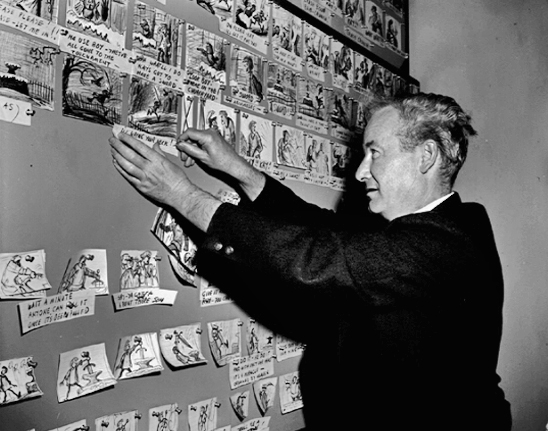 |
| Michael Sporn posted this still of Bill Peet-taken from the Sword in the Stone DVD-on his blog in 2008 |
Michael Barrier makes some sharp--and challenging--comments about the point of great character animation in his most recent post. He describes his friend, animator Milt Gray, flipping some of Ollie Johnston's animation of "Jock" from Lady and the Tramp, and being startled by the amazingly lifelike performance that sprung off the pages. Barrier continues:
The great virtue of Disney films like Lady and the Tramp was that they showed that such animation is possible. Their great vice was that they seemed to say, in a louder voice over time, that such animation is possible only in children's films.As a result, the temptation, if you're making more "adult" films, is surely to shrug off the Disney animators' lessons; but there's no way, if you're doing that, to achieve the emotional strength of their best work. A lot of animated filmmakers seem to think that they can work around that problem by making "story" their mantra, or by simply ignoring the question of how to give animated characters a vivid presence on the screen. But such dodges never succeed. It's only by meeting head-on the challenge of making the characters in their films as real as the best live actors that animated filmmakers will ever escape from the ghetto to which they have been, so far, rightly assigned.
Tough words...but I know what he's talking about, and I suspect most of my colleagues do, too.
To turn Barrier's premise inside-out, though, there have been some Disney films where "story" took a backseat to characters. In that category I'd put "Sword in the Stone" and "Jungle Book", both films I saw and loved as a kid and still love--but mainly for the performances of such as Shere Khan, Archimedes, Merlin and King Louis--not for the relatively weak story/plot and the corniest gags that are in them. Were the characters in those films not as entertaining and real as they are, there'd be pretty much nothing there but color and movement.
It's been said by wiser heads than mine that in the latter days of the nine old men, they were actors without a worthy stage, much like Laurence Olivier giving it his all in "Boys From Brazil" or "The Betsy". Feature animation was in a general doldrums; the kidvid ghetto was going full bore on TV, and there was no guiding hand at the world's most sophisticated animation company. It seemed to operate on the inertia of a more energetic time.
I think there are definitely pitfalls in having a story "mantra" that ignores just who's doing what in a film, though it's never intentional to sacrifice personality for plot--the aim is almost always the opposite, in fact.
Maybe there's a perception among non-artists of animation as having some sort of special needs, since our characters aren't seen in early development as castable flesh and blood actors, but are drawings and designs.
Of course the very, very early, embryonic beginnings of a feature film are a story's premise. If there isn't any story there to tell, well, that's trouble. It needn't be at as big as an epic, it can be small and even personal--but in the end it has to connect with a wide audience, and more than plot it's characters who carry that burden.
So to continue and develop that premise, assuming the story has something to work with it really does depend on the characters(that goes for the great shorts as well: Bugs Bunny trapped on a desert island is a hell of lot more interesting than Barney Bear trapped on a desert island or a Genericized Rabbit in that situation).
The story of a father fish looking for his lost son...okay. The story of a terribly neurotic, xenophobic, keep-to-the-reef father fish forced to plunge into deep seas, teamed up with various creatures he'd never want to deal with, but does it anyway, struggling all the while? Much better.
One doesn't want the plot running the characters, one wants the characters to be the plot--to make it their own one of a kind story, if you will. But(remembering "Sword in the Stone")they still need something worthwhile to do, and in a long-form story it probably can't be a one-set premise(never say never, but to generalize). No "Waiting For Godot"s. Pinocchio should get out of Gepetto's workshop. But personally I don't see any way forward in any story without nailing down the characters first. I have to know this person if I'm going to make drawings of them, and especially if I have to have them do or say anything.
Ideas come from drawing; good drawings--great drawings--come out of acting, the old "acting with a pencil" canard. It's really true. The more you know and love the characters, the more options for entertainment you'll have. They'll take over a scene in the same way novelists describe, with their characters. If you're taken in an entirely new direction, and it's going to work, it might be a very good thing when strong characters hijack you.
Mar 2, 2012
Fred Moore Pinup Girls up for auction today

This typical Fred Moore group of ladies en deshabille is being auctioned online today by Heritage. It's lot 78744, 12x13.5", watercolor and ink mounted on cardboard(as were many of Fred's "presentation" girls), and described as being from the estate of one John McLaughlin.
The bidding's currently at $1200(as of 10am PST). It's certainly going to be over my budget, but perhaps there's a Blackwing reader who'd be interested. Barring that, at least here's the artwork to peruse gratis.
This one looks like a later example of Fred's pinups-late '40s, I'd guess. Incidentally, the initial listing had this as a pinup by "Frank" Moore, with no mention of any Disney studio relationship. Someone set them straight(it's signed, after all), but I wonder what it might have fetched if left unrecognized among the Elvgrens and other rarities that comprise the illustration auctions Heritage does.
Feb 25, 2012
A Disney Story Session-for the Camera, 1951
I came across this today and thought I'd post it; I haven't seen it elsewhere although as one of many hundreds of such photos taken for publicity purposes, it's likely floating around somewhere. So here's a pretend-impromptu story session for "Alice in Wonderland" with some of the gentlemen of Disney's story department, including its first head, Ted Sears. Walt's holding the glasses he'd rather not be photographed in...actually, perhaps it really was an actual meeting. I wonder how many shots exist of Walt wearing his cheaters? There are some stats of Mary Blair's paintings down there amid the Milt Kahl model sheets; the sequence on the boards behind them is the Queen of Heart's croquet game.
The caption affixed to the reverse is reproduced here also. Erdman Penner, on the far right, died in 1956 aged 51; Ted Sears died two years later at just 58 years old. Winston Hibler passed away in 1976.

Just for the heck of it, here too is an example of one of Ted Sears' Christmas cards, upon which he expended a good deal of ingenuity and charm, and featuring his young family. This example comes from the Flickr stream of one molliesc, who posted a trove of them.

The caption affixed to the reverse is reproduced here also. Erdman Penner, on the far right, died in 1956 aged 51; Ted Sears died two years later at just 58 years old. Winston Hibler passed away in 1976.

Just for the heck of it, here too is an example of one of Ted Sears' Christmas cards, upon which he expended a good deal of ingenuity and charm, and featuring his young family. This example comes from the Flickr stream of one molliesc, who posted a trove of them.


Feb 24, 2012
Actually, every scene DOES get the storyboard treatment

Time magazine's online edition has a "behind the scenes" slideshow featuring Pixar's next release, Brave. Worth a look to see some nice photos of the crew(including one showing directors Brenda Chapman and Mark Andrews on a Scottish hillside covered in heather), but the accompanying captions by Jared Miller include one major error. Alongside a story panel from the sequence "The Prize" Miller writes[emphasis mine]:
Not all scenes get the storyboard treatment, but this one, called "The Prize," closely matches the scene as it appears in the completed film.
It's an odd aside, one that really only makes sense in live action where, as a matter of course, storyboarding is usually reserved only for particular scenes and sequences. As readers of this blog know, animated features are storyboarded from start to finish, top to bottom, left to right and every which way imaginable, over and over and over again. All the scenes in Brave did and do "get the storyboard treatment". Mr. Miller's assertion that it's not done for every scene is a major boner...if you're a story artist at least.
Not incidentally, the sequence as boarded is an impressive one-and the panel above of Merida taking aim is from the Time feature. There'll be much more of the boards in the forthcoming Art of Brave book. Available for pre-order now at a generous discount-a handy link's over there to the right. Yes, I just had to mention that.
Jan 10, 2012
Hope for Hand Drawn Animation: Minkyu Lee's "Adam and Dog" trailer
Traditional character/hand-drawn animator (and current Disney visdev artist) Minkyu Lee has been working on a personal film over the past two years, a short that from the looks of the footage I've seen proves it's possible for beautiful and polished work to be achieved by a very small number of individuals, if the people involved--and especially the person in charge--has the chops to pull it off.
Obviously Minkyu Lee does. This has the look of what we tend to call "classical animation". By the way, Minkyu painted all the backgrounds himself. There are only 6 key animators listed in his credits, all are friends and fellow CalArts grads with the notable exception of James Baxter(I think his work is immediately apparent in the short trailer). In additon, a dozen more artists not listed below, all of an obviously high caliber, helped finish it on their own time and in addition to their day jobs.
This is really something else.
Here are the credits as listed on the trailer's page:
Written and directed by Minkyu Lee
Animation by:
Minkyu Lee
Jennifer Hager
James Baxter
Mario Furmanczyk
Austin Madison
Matt Williames
Associate Producer:
Heidi Jo Gilbert
Technical Direction:
Ethan Metzger
Score:
Joey Newman
Film consultants:
Glen Keane
Thomas Ethan Harris

A complete list of everyone who contributed is on the film's Tumblr page, which is also where I got the accompanying artwork I've posted.
Obviously Minkyu Lee does. This has the look of what we tend to call "classical animation". By the way, Minkyu painted all the backgrounds himself. There are only 6 key animators listed in his credits, all are friends and fellow CalArts grads with the notable exception of James Baxter(I think his work is immediately apparent in the short trailer). In additon, a dozen more artists not listed below, all of an obviously high caliber, helped finish it on their own time and in addition to their day jobs.
This is really something else.
Adam and dog Trailer from Minkyu on Vimeo.
Here are the credits as listed on the trailer's page:
Written and directed by Minkyu Lee
Animation by:
Minkyu Lee
Jennifer Hager
James Baxter
Mario Furmanczyk
Austin Madison
Matt Williames
Associate Producer:
Heidi Jo Gilbert
Technical Direction:
Ethan Metzger
Score:
Joey Newman
Film consultants:
Glen Keane
Thomas Ethan Harris

A complete list of everyone who contributed is on the film's Tumblr page, which is also where I got the accompanying artwork I've posted.
Dec 20, 2011
Merry Christmas from a couple of legends
 | ||||
| A Christmas card from Ray and Charles Eames |
Watch Charles & Ray Eames: The Architect and the Painter on PBS. See more from American Masters.
 | |
| Bob Wirth |
Also displayed are two other holiday cards that were sent to the couple, from the collection of the Library of Congress:
 |
| Lee Krasner and Jackson Pollock |
Dec 17, 2011
Icons of Animation-another great Fred Moore piece going, going...

[5pm PST: it sold for the low-end estimate of $3,000]
Dec 15, 2011
Christmas in Manhattan, 1934
...as imagined by Frances Goodrich, Albert Hackett, Woody Van Dyke, inspired by Dashiell Hammett and interpreted by Myrna Loy, William Powell and Asta, I give you Christmas morning with the Charles family.
Dec 13, 2011
A Merry Christmas from Disney's in 1955
This is a repost of one of my earliest entries, shortly after I began this blog in 2005. I think it suits the season and so merits an encore.
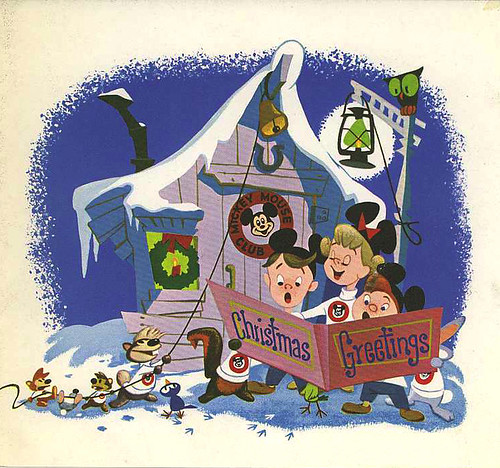
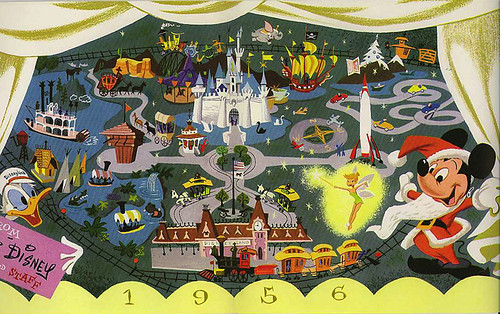
This is the front of the Disney Studio's 1955 Christmas card. It's quite a beautifully done thing; printed on a soft, high-quality paper, it's a large card that opens into a double-spread of the brand-spanking-new Disneyland, with a calendar running down the sides. I was unable to scan the entire thing, as it's just a bit longer than my scanner is. Great artwork--I don't know whose...anyone have any ideas?
May your fifty-years-on New Year be merry and bright!
This is the front of the Disney Studio's 1955 Christmas card. It's quite a beautifully done thing; printed on a soft, high-quality paper, it's a large card that opens into a double-spread of the brand-spanking-new Disneyland, with a calendar running down the sides. I was unable to scan the entire thing, as it's just a bit longer than my scanner is. Great artwork--I don't know whose...anyone have any ideas?
May your fifty-years-on New Year be merry and bright!
Dec 8, 2011
Bravery

In other Brave-related news, Brenda Chapman began using Twitter and has started a Tumblr blog. There's not much there yet as she only just began it, but it does link to a new, very good two-part interview with Brenda on the site Pixar Portal. Her thoughts on art, work and storytelling are a must-read.
Nov 15, 2011
The Story Man, or Plus ça change, plus c'est la même chose
 | ||||
| Heck Allen, Tex Avery's story man, in 1953. He stands outside the MGM animation building. This and many others are from Michael Barrier's indispensable animation history blog . |
Ed gave his slides and other photographs to Michael Barrier for inclusion in his book of animation history, "Hollywood Cartoons". They didn't make it in then, but happily can now be enjoyed gratis thanks to Mike's posting them here:
Michael Barrier's unpublished color photographs of Tex Avery's unit, taken by Ed Benedict.
Even in their early-fifties sartorial splendor of coats and ties, color seems to make the subjects younger, livelier, more real than is usually the case(I'm sure posing for their buddy Benedict didn't hurt either). But what really jolted me from out of the past was the portrait of lanky Heck Allen, gagman extraordinaire, pictured above. The only thing that distinguishes him from story guys walking down the hall from me today is the crease in his pants. History repeats itself-in some things, at least.

And here's the man himself, Tex Avery, from that same collection on Barrier's site. Look at that high stack of scripts-or script notes-or annoying memos from Quimby on the desk. And what's in those boxes to his right?
Go, go, go right away and look and read what else Mike's been posting. I promise you, if you have a real interest in animation history-Disney, Warner Bros, golden age comics-you'll be glad you did. I always am.
Sep 7, 2011
Fred Moore's 100th

Robert Fred Moore, animator, was born on this day, September 7, 1911. 100 years on and his influence is still meaningful in the films he worked on, the characters he helped define, and the effortless joy of his draftsmanship. Happy Birthday, Fred!
Edited to add: I wrote this before seeing the wonderful post Andreas Deja wrote to mark this occasion. Andreas is a great admirer of Fred's work and has one of the finest collections of animation art in private hands-including a large selection of Fred's animation work and personal drawing. The prostrate figure below is one I've never seen before (I'm guessing it came to Andreas through his friend and former colleague, Ollie Johnston). Typically lovely. Head to Andreas' blog to see much more of Fred's art: Deja View

Subscribe to:
Posts (Atom)


 Posts
Posts


