Showing posts with label walt disney. Show all posts

Sep 11, 2014

New Book Review: The Lost Notebook: Herman Schultheis & the Secrets of Walt Disney's Movie Magic


It takes a long time to look through John Canemaker's new book  The Lost Notebook: Herman Schultheis and the Secrets of Walt Disney's Movie Magic, and it should. Nearly 300 pages are filled with examples of every aspect of Disney's production: drawings, model sheets, camera setups, and hundreds upon hundreds of photographs of how shots were achieved, animators at work, models posing for animators, reference photos of animals and humans, cels, drawings, the Burbank studio being built, "The Reluctant Dragon" live action production, Bambi, Fantasia, Dumbo, Pinocchio. Numerous examples of Freddie Moore's girl drawings(reference for Fantasia's centaurettes), miniatures and models...from an effects perspective, but also just everything that clearly interested the compiler, Herman Schultheis, personally. With few exceptions none of it would normally ever be seen by the public, and most of it never has been-until now.


A page showing development for Fantasia
Ink & paint artist Mildred Rossi is sketched by Ethel Kulsar during production of Reluctant Dragon

One has to wonder if John Canemaker or Howard Lowery, both as knowledgable as anyone alive about the history of the Walt Disney Studio, had ever heard the name Herman Schultheis when his notebooks chronicling working life at Disney came to light some 15 years ago.  He wasn't a painter or  draughtsman, animator or story artist. His employment at Disney's was brief, lasting barely more than two years. In a time when so few of the rank and file of animation received any sort of public acknowledgment he was obscure-one man among hundreds working at Hyperion and Burbank on Pinocchio, Bambi, Fantasia, and the rest of the landmark output of that greatest of studios.  He remained unknown as the decades progressed and the films made during his tenure there became known as the "golden age', and historians, students, buffs and professionals who cared about animation learned the names and accomplishments of many of his colleagues.

Anyone studying the histories of those working at Disney's at its peak finds an impressive roster of geniuses, misfits, iconoclasts, goofballs and self-made men and women, but even in that company Herman Schultheis was an odd duck. Ambitious, egocentric, tremendously talented and curious, he was in love with the filmmaking process before he gave any thought to applying at Disney. A man fascinated by details, he compulsively and enthusiastically cataloged everything he did, but especially everything he saw.

Schultheis had emigrated to the United States from Germany in 1927 when he was already 27 years old. Initially living and seeking work on the east coast, he had, quoting from Canemaker's text:

[A] degree in electrical engineering, a gift for photography, a thorough knowledge of music, and a love of travel".
He was charming, indefatigably ambitious and without a shred of self-doubt. But as Canemaker points out, though talented(particularly as a photographer), Schultheis was indeed a "jack of all trades, master of none"-such a distinction then as now making the kind of all-encompassing creative and technical work he craved hard to come by.

After various jobs in NY, he moved to Hollywood determined to work in the motion picture industry-ideally as a sort of uber-supervising creative engineer, to judge from his letters and self-promotion. Although he worked some very good connections, none of the studios could quite figure out how to use him and nothing panned out-until he managed to talk his way into a job at the Disney Studios on Hyperion.  Hired to apply his skill in the Process Lab, he was paid for an initial trial period the princely sum of $40 a week. This at a time when, according to animation director Shamus Culhane in his memoirs, animation trainees hired right off the street were paid $50. But it was something, and it was a job at a film studio-albeit animation.

Details of some of Fantasia's effects-incrdible information. This photograph from John Canemaker's page


 In fact, it was actually a perfect fit: Disney's at that time encouraged cross-pollinating between departments to solve problems and hands-on, "can-do" invention was encouraged to an extent that would soon largely disappear. But with films like "Pinocchio" "Fantasia" and "Bambi" in the works, there were incredible effects to be achieved-one way or another.

And Schultheis, apart from his work in improving photostatic quality on model sheets, cels, and various other tasks, documented it all, compiling extensive scrapbooks using animators' drawings, model sheets, diagrams, and loads of his own photographs. What results is a wizard's book of beautiful, extensive setups of how everything was done. It's truly incredible.
Of course my jaw dropped upon seeing this page...Hello, Fred Moore! Centaurettes in the making.

The book is stunning-beautifully bound and printed. And although the scrapbook's contents would be more than enough for any such project, Canemaker has included additional examples of Schultheis' beautiful and fascinating photography to illustrate his story. The entire scrapbook is not only reproduced in a full facsimile, but annotated.  Now everyone can have their own copy of this eye-popping, historic volume to refer to it at any time.

 In addition, all the necessary context of Herman Schultheis, his life and times and that of the Disney Studio during his time there is described in Canemaker's typically elegant and sympathetic prose.  As beautiful as the scrapbook is, I was struck by the ultimately poignant trajectory of Schultheis before, during and after his Disney employment. Had he been a different sort of character, less oblivious of how his sense of superiority probably undermined him among his colleagues, he might have stayed at Disney throughout the war years and worked on such projects as "20,000 Leagues Under the Sea", or on the production of Disneyland.  That didn't happen, and the by-then intermittent adventurer "disappeared" into the jungles of Guatemala in 1955; his bones where discovered shortly afterwards.

Schultheis in the 1930s


A self-portrait shows the handsome german posing in pith helmet and khakis under swaying palms, looking for all the word like Paul Belloq from"Raiders of the Lost Ark".  His lost notebook, hidden away for decades after his death, was rediscovered by Howard Lowery and is now under glass and viewable via a digitized version thanks to its acquisition by the Walt Disney Family Museum. Also thanks to the Museum and the efforts of the late Diane Disney Miller, John Canemaker has written and assembled this beautiful book version for all to own and enjoy. It's a certainty that Herman Schultheis would have welcomed our rediscovery of his lost, and finally found, Notebook.

Under the book's dust jacket. An embossed reproduction of Schultheis' UFA-inspired monogram.

The Lost Notebook: Herman Schultheis & the Secrets of Walt Disney's Movie Magic
By John Canemaker
Foreward by Pete Docter
Hardcover, 288 pages
Published by Weldon Owen
12.1 x 12.2 x 1.2", 5.4lbs


Aug 22, 2013

The Imagineering Story: Disney's WED gets the Iwerks treatment in 2016

Have a look at this trailer, premiered at the recent D23 event and written up in Los Angeles Magazine by Chris Nichols:

It's being produced by a filmmaker with sterling credentials for the job, documentarian Leslie Iwerks-granddaughter of Ub and daughter of Imagineer Don.
 
This promises to be a must-see that I only wish weren't three years away. Behind the scenes footage of the early days of Disneyland and  EPCOT always gets me as it clearly does so many others: seeing Walt's pitching skills at their finest, giving us "tours" and glimpses inside Flower St. buildings with mind-bendingly talented men and women working away inside...great stuff, and fortunately there are still veterans from those years that appear in Iwerks' film to speak for themselves and their experiences, among them Alice Davis and Bob Gurr.
 
From the LA magazine post-a shot of Walt with-is it Anaheim city officials?-taken around 1949 or so. My guess based on his appearance. I should know better, but don't.The article credits the Orange County Archives.


Feb 25, 2012

A Disney Story Session-for the Camera, 1951

I came across this today and thought I'd post it; I haven't seen it elsewhere although as one of many hundreds of such photos taken for publicity purposes, it's likely floating around somewhere. So here's a pretend-impromptu story session for "Alice in Wonderland" with some of the gentlemen of Disney's story department, including its first head, Ted Sears. Walt's holding the glasses he'd rather not be photographed in...actually, perhaps it really was an actual meeting. I wonder how many shots exist of Walt wearing his cheaters? There are some stats of Mary Blair's paintings down there amid the Milt Kahl model sheets; the sequence on the boards behind them is the Queen of Heart's croquet game.
The caption affixed to the reverse is reproduced here also. Erdman Penner, on the far right, died in 1956 aged 51; Ted Sears died two years later at just 58 years old. Winston Hibler passed away in 1976.


Just for the heck of it, here too is an example of one of Ted Sears' Christmas cards, upon which he expended a good deal of ingenuity and charm, and featuring his young family. This example comes from the Flickr stream of one molliesc, who posted a trove of them.


Sep 24, 2009

A Disney Dream realized: The Walt Disney Family Museum is about to open


Interior of one of the galleries of the Museum. Photographed by and used with the permission of David Lytle.


Last year out of the blue I received an email asking about one of the photographs I've featured on my blog. This happens fairly often, but this time the source knocked me for a loop: it was the people who were amassing exhibits for the long-awaited Walt Disney Museum underway up in San Francisco, in the stunningly beautiful Presidio. Would I be amenable to helping? Is Fred Moore my favorite good girl artist? Is the Blackwing a pencil?


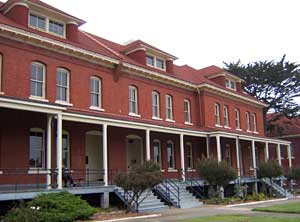
The circa 1890 barracks at San Francisco's Presidio. They had to be very carefully modified and worked around by the Disney Museum's architect to meet the requirements of this historic site

Of course I was happy to be able to help out in any way however small. When dropping my original off I was privileged to be shown an elaborate virtual walkthrough, examples of exhibits, and an overall idea of what the museum would be and look like. I found it utterly exhilarating. Truly worthy of Disney's oft-expressed vision of educating coupled with appeal and fun, it's clearly been based on his own approaches to those goals.

The cover to a Museum book that will be available at its bookstore in October. In addition to the store, there's also a theater, a cafe and an education center as part of the campus.

I won't see it myself until tomorrow at a preview, but if it's anything like the plans it's going to be a standard for this sort of place. Walt Disney's life and career contained experiences so simultaneously relatable and visionary, combining spectacular success with equally numbing failures (from which he managed to recover despite sometimes terrible odds--a point the Museum intends to make clear as part of its presentation) that he easily deserves a permanent educational resource of this kind. It's one his family, in particular his daughter Diane Disney Miller, have worked tirelessly to make happen. It's a shame that it's not located in Los Angeles, but having lived in that city for most of my life I can't say I'm amazed that the project couldn't be realized here. And it does make an excellent excuse to make more trips to the Bay Area if anyone needed one.

Opening day is almost here: October 1st. The Museum has been sending me various materials from its holdings and (I'd imagine) displays, a few of which are illustrated here.

Walt and Diane in Los Feliz in the 30s, a stone's throw from the Hyperion studio

Regardless of Walt's telegram, you just know Roy worried.

Yet another rare piece of visual development from a woman Walt gave a unique opportunity to: Mary Blair


Funny--it doesn't say "Park" anywhere on this billboard

It wasn't all work and no play: Walt learned to ride as my own father did-on a midwestern farm. Years later he used this saddle where I've ridden today: the Santa Ynez Valley. Don't know why the color swatches are there.


I wish I knew who drew this board for "Mary Poppins" so I could attribute it-anyone? Note the aspect ratio

After Friday I'll post my impressions; in the meantime, I'd think that regular readers of this blog--assuming you're still around--will have to start planning that little jaunt to San Francisco now.


The Walt Disney Family Museum
104 Montgomery Street
The Presidio of San Francisco
San Francisco, CA 94129

T 415 345 6800


Mar 6, 2009

Walt Disney, Railroader


From the collection of veteran Disney story artist and comics guy Don Dougherty come these terrific shots of Walt enjoying his obsession, apparently taken at the studio. As to who's who and exactly what year these were shot, I'm open to suggestions.
EDITED TO ADD: A commenter named Steve offered this great extrapolation on the photos:

"The top and bottom photos, as I recall (don't have my Broggie book in front of me) was taken in December 1949 during the Lilly Belle's first steam up. That's Eddie Sargent standing between Walt and Roger. He did the drawings for the Lilly Belle.

The British engine with Walt in the middle was never run at Carolwood--it was damaged as it was being shipped over from England. However, you may want to note that when Walt was in the store buying that engine, another gentleman was trying to buy it as well. His name was Harper Goff. He didn't get the engine, but he did get a job at the Disney studios.


Must be clicked to see them better. Thanks for sharing, Don[and Steve]!

Jan 7, 2009

Where's Walt? a Disney photographic mystery posed by Michael Barrier


Please click this photograph of Walt Disney somewhere in (I believe) Irish waters in 1946, and see if you can tell what shoreline that may be behind him. Is it England? Could it be America?

In the course of his years of research, author Michael Barrier (his latest, "The Animated Man: A Life of Walt Disney" is a must) has collected a lot of fascinating ephemera, including a couple of photos of Walt that even he can't be exactly sure of--though he gets pretty close. The above is one of two that show Walt on board ship in late 1946.
I borrow it here as I know that a 1) a lot of Irish and UK people read this blog and might be able to ID a black and white image from the late 40s, and 2) because it's not often enough that I point readers to the Barrier blog, which always has plenty of interest to enjoy.
Michael Barrier
photograph of Walt Disney from michaelbarrier.com

Jun 22, 2008

Good Morning! Disney Commissary Breakfast Menu circa 1940


Following up on my earlier post with the lunch menu from the Disney Burbank commissary (or "Studio Restaurant" as it's called here), I discovered the place was swanky enough to have not one but at least two specially-made menus for mealtimes. Here's what you would have seen if you'd arrived like Donald at about 8:34 am in about(my guess)1940:

(click the interior of the menu to read it):


Makes one hungry, doesn't it?

(for the record, it measures approximately 9x5.5" when closed)

Apr 16, 2007

Review: The Animated Man: a life of Walt Disney


Walt and his wife Lillian arriving in England in 1946; from "The Animated Man" by Michael Barrier

As I've written before, my respect for Michael Barrier goes back to the late 1970s when he was publishing his magazine Funnyworld. The contents were an animation fan's dream: interviews, essays, illustrations and reviews all about cartoon animation of the golden age. There was never anything close to it before, and in the decades since there's been but one similar effort, Amid Amidi's excellent Animation Blast.

It makes sense that given the huge interest in animation since the late 1980s at least one serious magazine about animation would exist now, but when Barrier was putting out Funnyworld it stood totally alone in a barren landscape of dry film journals who, if they deigned to discuss cartoons at all, usually reserved their attention for "serious", "artistic"(read: abstract, non-narrative) animation. They wouldn't have given the likes of Bob Clampett or Walt Disney the time of day unless it was as a dartboard for sexism/racism/facism/freudian subtext in cinema. Dull times indeed.

From Funnyworld I gleaned that Barrier was a stickler for facts, interested in detail, and had formed very strong views about the various studios' output. His standards of what makes good or great animation were obviously high, but he knew enough about the techniques and context of studio animation to avoid a common stumbling block I've noticed--that of comparing apples to oranges, and finding apples lacking. That is, he appreciated the Warner Bros. best output just as much as he did the best of Disney's(you'd be hard pressed to find the same broad view taken by most of the veteran artists of that age).

His last book, Hollywood Cartoons, was written with great weight given to the Disney studio--and considering the impact Disney's work had on how the world perceived animation of the so-called golden age, that made sense. It also made me eager to read Barrier's take on a man he had heard so much about from so many of his closest colleagues and employees: Walt Disney.

Since I write this blog as an animation artist and fan, and that's who I write it for, I'll put it this way: Animated Man is the book I've always wanted to read on Disney the person, and the one that I've enjoyed the most (of the two recently released and the previous few), because it's plain the author understands exactly how animated cartoons are and were made--what they are, what they can be, and how it felt to work for Walt Disney at that incredible time in history, for better or worse.

Years of research and hundreds of hours of interviews with so many artists employed by Disney clearly did that for Barrier. Although he obviously finds Walt admirable and fascinating(which he inarguably was), he never deifies him or avoids describing--through first person interviews, letters, articles and quotes--the rough edges that made up a complicated, brilliant individual. I simply don't get that feeling--that tingling at the nape of the neck, if you will--from most other authors' attempts at portraying Disney that I got from this book: that I was getting a glimpse of the real person, as much as anyone at this far remove of time and commercial ossification ever could.

A striking addition to this biography lacking in so many others is the number of long-forgotten articles in major magazines Barrier tracked down and quotes from. They're fascinating reading. Often they reveal startlingly frank descriptions of Walt's manner and appearance--much more so than one would think possible from, say, a McCalls magazine of the 1940s. It tears away the veil of reverence that's obscured the real man, resulting in Walt Disney being made over into "Uncle Walt"--a jovial, grandfatherly, completely unintimidating figure as mythical as any of his characters, if not more so.
This phony Walt, well-meant as the image might be, is terribly unfair to a man whose contradictions and flaws were just as vital to his makeup and his success as were his boundless enthusiasms, entrepreneurial spirit and imagination.

From Barrier we get neither a candy-coated view of Disney nor a fashionably po-mo slam; the context of the particular time is always clear, and made meaningful--not necessarily to Disney's benefit as an "icon", but always fair. One may occasionally wince at what one reads, but never does it ring false. Rather, it made me respect and appreciate the complete man even more--and really, really appreciate the difficulties of working for him on his greatest projects--and his failures. Since the sucess of the Disney studios depended so heavily on the contributions of many artists, we are treated to much fascinating information about those men and (few) women--including much more previously unpublished material than I expected to find. It's a biography of Walt Disney the individual, but it's also a great history of animated film production itself--since Disney virtually was his studio, as attached to it as Nemo was the Nautilus.

Certainly some of Barrier's positions buck the mainstream--one example: he feels "Mary Poppins" is a deeply flawed film. Personally I fall more into the Leonard Maltin group; despite its length and miscasting I loved the movie, as I do the completely different Travers books. Same goes for "Jungle Book"--both the film and the great novels.

But the fact is that every biographer had better have opinions, hopefully strong ones where his chosen subject is concerned. All I expect is that the author will express himself in such a way that I want to keep reading and feel I'm getting an honest context for a life--even if one or another of the author's stated opinions make me want to hurl the book across the room. Disagree though I might I never got to the hurling stage with Animated Man, and that's a tribute to the sagacity of the writing.

As a kid I interviewed some animation veterans who'd worked closely with Walt. From some of them, particularly Ward Kimball and Art Babbitt, I got much more than I expected or could process at age 17 about just how ambivalent these men's emotions were towards their onetime boss.
Their various contradictory views flummoxed me. Nothing in Bob Thomas prepared me for what they had to say, and I realized that I really had no idea of who Walt Disney was. If I'd been able to read The Animated Man beforehand it all would have made a lot more sense to me.

I have to believe that The Animated Man is the definitive book on Walt Disney's life and work, and likely to remain so for quite a while. If you have more than an average interest in Disney or animation or film production as it was from the 1920s to the 60s, this will more than suit. It's a must-have.

The Animated Man: A Life of Walt DisneyUniversity of California Press 411pp $29.95
Addendum: I can't think of anything to strongly quibble with in the book save one(and it really is but a quibble, of limited import): I think Barrier somewhat missed the boat in his description of Calarts, the instituion that Disney personally planned from the ashes of the venerable Chouinard Art School that gave the studio so many of its artists.

He describes the current campus as a "huge structure" when it's actually quite small, comprising a single building with no more then two floors of classrooms and space(I'm leaving out the notorious sublevel). Frankly the campus' five schools (film-dance-art-music-theatre) are if anything too crowded, as the building has never been substantially enlarged since its construction in the early '70s. And while Barrier points out that Walt's Calarts vision of a cross-pollinating melange didn't truly happen as he'd imagined, he doesn't mention the fact that at the very least, Calarts' music program is one of the most respected in the United States--and yes, we animation students were exposed to constant sounds of rehearsals, gamelan-jamming, jazz improvisation and dancers warming up in the shared hallways, and some cross-use between departments did occur. The theatre school too is extremely well-respected.

And without the creation of the Character Animation department (as well as Jules Engel's slightly earlier Motion Graphics department) it's more than likely that any training at all of "Disney" animation wouldn't have happened outside the studio itself, or been available to any of the lone bunch of the era who still dreamed of feature animation performance and filmmaking--of creating "the illusion of life"--being a possible, viable career.
Nevertheless, Barrier deserves credit for mentioning Calarts as being important to Walt at all as most writers on Disney completely ignore its importance in his life outside of the character animation classes' continuing additions to animation credits.

Jan 15, 2006

Walt Disney, a trifle discomfited

Here's another personal find from my days working at Larry Edmunds Bookshop--unpublished so far as I know:

What an expression. That's a pretty uncomfortable-looking man, wouldn't you say? The famous "cocked eyebrow" isn't at full sail but as a story artist I can just imagine the effect this look would produce after an unsuccessful pitch. Wow. Warners better be hiring!

From the presence of the flag behind him, I'd guess this was taken during Walt's testimony during the HUAC hearings--the infamous McCarthy-era search for communists in every facet of american society that resulted in the evils of the blacklist in Hollywood.
One of my rare pre-K memories is of Walt Disney as host of "The Wonderful World of Disney" and his death soon after I started watching it was a huge shock. That evening my family were at the home of two retired university professors, friends of my parents, for dinner and some television. I remember the news coming on with the announcement that "Walt Disney, beloved by millions, has died".
I really lost it at that point. I was four years old, and my father was infuriated that I was making a scene over the death of someone I didn't know. Of course, this wasn't true--I did know Disney, personally as far as I was concerned. It mattered to me that he was dead. His was the first death of any kind I remember understanding and grieving over.
I've always detested the "Uncle Walt" moniker as it's been used so sarcastically and cynically in these po-mo times. He wasn't my uncle, thanks, but a sort of family friend, much like the couple we were visiting, and I was inconsolable.

In the years since I've pondered this emotional reaction and realized that it had to do with a collection of things: the fact that he spoke directly to the television audience from his office, not as a "host" or newscaster but in a startlingly personal and casual way; the ownership and creation of Disneyland, where as a Californian I'd been going since I was born; the films he produced just for me that were more vivid and real than anything else I saw and cared about, excepting the Warner Bros cartoons that were my favorites.
So then, this picture: not a happy guy here...but oddly enough, although I respected and in a way loved Disney as a child, I sensed that he wasn't some fantasy figure of unalloyed sweetness (I mean, how could a late-middle-aged man ever seem to be that to a very small child?). He had a very distinct element of impatience, too, and the possibility of a temper. I'm not saying I analyzed all this at four, but he was definitely intimidating, and I just knew it was in there somewhere.
Had I seen him at Disneyland, I would not have run up to him expecting a hug, exuberant child that I was notwithstanding. But complicated people are attractive and fascinating even to children when their enthusiasm embraces small animated people on their desks under their blotters, or when they show completely genuine excitement while taking us through a boat ride with pirates, or share some "secrets" of animation from a massive tome.
It came as no suprise to me, then, when I eventually read the reminiscences of Ward Kimball, Dick Huemer (again, in Michael Barrier's Funnyworld), Shamus Culhane and others who described the wildly mercurial qualities that Walt possessed.
Creative genius usually comes that way.

More blogs about animation.
Technorati Blog Finder