Showing posts with label walt disney family museum. Show all posts

Jun 10, 2020

The Walt Disney Museum's Fred Moore Q&A

Is it 2021 yet? Because as of this writing in June 2020, it sometimes feels as though it may never get here. I think every one of us lives in hope for a better, brighter, wiser tomorrow to come.

In a\this time of upheaval unprecedented for almost everyone alive, writing about animation history can feel like a pursuit too trivial to attempt, but there's still value in communicating and hopefully evoking an understanding of what's come before in our art form. Animation artists are fortunate to be able to continue working on projects of all kinds, sharing work, drawing inspiration from each other, as well as from the best of the past.

From Andreas' collection, a Fred rough from Pluto Plays Football(unproduced, 1952)


Last fall I prepared answers to questions submitted by the Walt Disney Family Museum about Fred Moore and his relationship with Mickey Mouse. Initially this was meant to run concurrently with their exhibition on Mickey(beautifully curated by Andreas Deja), but a backlog resulted in it going live shortly after the exhibition's close in February. It can be seen on their blog along with many more fascinating posts on all subjects of Disney studio history, Here are links to my Q&A, presented in two parts.

This is also a reminder that the Museum continues to offer great programs-online, for now. Please pay them a visit, virtually and otherwise. They have much to offer.

Artist and Author Jenny Lerew Talks Mickey Mouse and Animator Fred Moore, Part 1

And here is a direct link to Part 2.


Jul 17, 2016

Wish Upon A Star: The Disney Family Museum's new exhibit devoted to Pinocchio-curated by John Canemaker


The Diane Disney Miller Hall at the museum with original "Pinocchio" posters on display.

Film critics, animation professionals, students and afficionados generally agree that the first five feature films released by the Walt Disney Studio achieved a standard they never surpassed. Where opinons diverge is which was the greatest, "best", most satisfying or artistically successful: "Snow White and the Seven Dwarfs", Pinocchio", "Fantasia", "Dumbo" or "Bambi"? Just looking at the list makes comparisons and rankings seem beside the point. It's stupefying to consider what one place of business managed to produce within a span of seven-odd years, expanding and refining the art of animated film at a pace never equaled since.

For me, the Disney studio's pinnacle was "Pinocchio". From its soaring, wistful opening music to exploring the darkest places a fairy tale can go and back again, it delivers entertainment via animated design and acting polished to the nth degree. Even the credits are beautifully presented. Imagine working with this group-for more than half of them, it would be their first time supervising:


Now a new exhibit at the Walt Disney Family Museum makes it possible for a visitor to immerse themselves in the process of creating this magnificent film. Curated by the Academy Award-winning animator/historian/writer/professor John Canemaker, it's a beautifully presented, comprehensive journey through the making of an animated feature at Disney's in the late 1930s. In other words, for an animation student, fan or professional, it's bliss.

To my knowledge there's never been as much original material from one of the original five productions on view before. Featuring materials from the Disney Museum's holdings, the Walt Disney Studio Archives, and many, many private sources, it's likely only an artist with the reputation, awareness and taste of Canemaker could have pulled it all off. The exhibit fills the two floors of the Diane Disney Miller Hall at the museum, starting on the second floor with Collodi's original book, and channeling the visitor through production design to story, animation, effects and camera. 
Film critics, animation professionals, students and afficionados generally agree that the first five feature films released by the Walt Disney Studio achieved a standard they never surpassed. Where opinons diverge is which was the greatest, "best", most satisfying or artistically successful: "Snow White and the Seven Dwarfs", Pinocchio", "Fantasia", "Dumbo" or "Bambi"? Just looking at the list makes comparisons and rankings seem beside the point. It's stupefying to consider what one place of business managed to produce within a span of seven-odd years, expanding and refining the art of animated film at a pace never equaled since.

Walt pitching "Pinocchio".
All this is represented by a collection of over 300 treasures, including Ward Kimball's continuity script, original paintings by Tenggren, drawings by Hurter, many story sketches and layout drawings, animation roughs-both the originals under glass and reproduced on tables as thick sheafs of animation that can be flipped by guests. An area designed as Gepetto's workshop would be features original plaster maquettes of many of the characters made in Joe Grant's "model department"-including two different sculptures of Monstro the whale, Stromboli's caravan, and "real-sized", working marionettes of Pinocchio and one of the Dutch puppets from Stromboli's show(these are particularly-and typically-detailed and beautiful).

From the Instagram account of the WDFM.
Courtesy The WDFM Instagram account.
In the animation area, you can pick up a phone to hear Frank Thomas describing how to handle animating Pinocchio-copied from a disc recording made by Frank, probably for the benefit of those animators and assistants who weren't invited to the live lecture he gave on the subject. In another room, a model has been made of the multiplane camera setup, showing visitors how the cameramen photographed the still-eyepopping pan/truck-ins in the film and gave it it's sense of depth. Just incredibly cool.

There's so much there to see-not only a tribute to a beautiful film, but a perfect audio/visual primer to the work of animation production. We can't drop in at Hyperion in 1938 and see what Ward and Milt and Woolie are up to as they break for lunch, alas-but this is as close as we can hope to get. I bang a drum for the Disney Museum every so often-really, far too many people, myself included, put off getting up to San Francisco to visit. By all means make the trip before January 9th and see what John Canemaker and the creative and welcoming Museum folks have wrought. You're going to love it.

John Canemaker, curator. Photograph from his website.


"Wish Upon A Star: The Art Of Pinocchio" runs through January 9th, 2017.

Museum hours are 10am–6pm. Last entry 4:45pm.
Open daily except Tuesdays, January 1, Thanksgiving Day, and December 25.


SaveSave

Sep 11, 2014

New Book Review: The Lost Notebook: Herman Schultheis & the Secrets of Walt Disney's Movie Magic


It takes a long time to look through John Canemaker's new book  The Lost Notebook: Herman Schultheis and the Secrets of Walt Disney's Movie Magic, and it should. Nearly 300 pages are filled with examples of every aspect of Disney's production: drawings, model sheets, camera setups, and hundreds upon hundreds of photographs of how shots were achieved, animators at work, models posing for animators, reference photos of animals and humans, cels, drawings, the Burbank studio being built, "The Reluctant Dragon" live action production, Bambi, Fantasia, Dumbo, Pinocchio. Numerous examples of Freddie Moore's girl drawings(reference for Fantasia's centaurettes), miniatures and models...from an effects perspective, but also just everything that clearly interested the compiler, Herman Schultheis, personally. With few exceptions none of it would normally ever be seen by the public, and most of it never has been-until now.


A page showing development for Fantasia
Ink & paint artist Mildred Rossi is sketched by Ethel Kulsar during production of Reluctant Dragon

One has to wonder if John Canemaker or Howard Lowery, both as knowledgable as anyone alive about the history of the Walt Disney Studio, had ever heard the name Herman Schultheis when his notebooks chronicling working life at Disney came to light some 15 years ago.  He wasn't a painter or  draughtsman, animator or story artist. His employment at Disney's was brief, lasting barely more than two years. In a time when so few of the rank and file of animation received any sort of public acknowledgment he was obscure-one man among hundreds working at Hyperion and Burbank on Pinocchio, Bambi, Fantasia, and the rest of the landmark output of that greatest of studios.  He remained unknown as the decades progressed and the films made during his tenure there became known as the "golden age', and historians, students, buffs and professionals who cared about animation learned the names and accomplishments of many of his colleagues.

Anyone studying the histories of those working at Disney's at its peak finds an impressive roster of geniuses, misfits, iconoclasts, goofballs and self-made men and women, but even in that company Herman Schultheis was an odd duck. Ambitious, egocentric, tremendously talented and curious, he was in love with the filmmaking process before he gave any thought to applying at Disney. A man fascinated by details, he compulsively and enthusiastically cataloged everything he did, but especially everything he saw.

Schultheis had emigrated to the United States from Germany in 1927 when he was already 27 years old. Initially living and seeking work on the east coast, he had, quoting from Canemaker's text:

[A] degree in electrical engineering, a gift for photography, a thorough knowledge of music, and a love of travel".
He was charming, indefatigably ambitious and without a shred of self-doubt. But as Canemaker points out, though talented(particularly as a photographer), Schultheis was indeed a "jack of all trades, master of none"-such a distinction then as now making the kind of all-encompassing creative and technical work he craved hard to come by.

After various jobs in NY, he moved to Hollywood determined to work in the motion picture industry-ideally as a sort of uber-supervising creative engineer, to judge from his letters and self-promotion. Although he worked some very good connections, none of the studios could quite figure out how to use him and nothing panned out-until he managed to talk his way into a job at the Disney Studios on Hyperion.  Hired to apply his skill in the Process Lab, he was paid for an initial trial period the princely sum of $40 a week. This at a time when, according to animation director Shamus Culhane in his memoirs, animation trainees hired right off the street were paid $50. But it was something, and it was a job at a film studio-albeit animation.

Details of some of Fantasia's effects-incrdible information. This photograph from John Canemaker's page


 In fact, it was actually a perfect fit: Disney's at that time encouraged cross-pollinating between departments to solve problems and hands-on, "can-do" invention was encouraged to an extent that would soon largely disappear. But with films like "Pinocchio" "Fantasia" and "Bambi" in the works, there were incredible effects to be achieved-one way or another.

And Schultheis, apart from his work in improving photostatic quality on model sheets, cels, and various other tasks, documented it all, compiling extensive scrapbooks using animators' drawings, model sheets, diagrams, and loads of his own photographs. What results is a wizard's book of beautiful, extensive setups of how everything was done. It's truly incredible.
Of course my jaw dropped upon seeing this page...Hello, Fred Moore! Centaurettes in the making.

The book is stunning-beautifully bound and printed. And although the scrapbook's contents would be more than enough for any such project, Canemaker has included additional examples of Schultheis' beautiful and fascinating photography to illustrate his story. The entire scrapbook is not only reproduced in a full facsimile, but annotated.  Now everyone can have their own copy of this eye-popping, historic volume to refer to it at any time.

 In addition, all the necessary context of Herman Schultheis, his life and times and that of the Disney Studio during his time there is described in Canemaker's typically elegant and sympathetic prose.  As beautiful as the scrapbook is, I was struck by the ultimately poignant trajectory of Schultheis before, during and after his Disney employment. Had he been a different sort of character, less oblivious of how his sense of superiority probably undermined him among his colleagues, he might have stayed at Disney throughout the war years and worked on such projects as "20,000 Leagues Under the Sea", or on the production of Disneyland.  That didn't happen, and the by-then intermittent adventurer "disappeared" into the jungles of Guatemala in 1955; his bones where discovered shortly afterwards.

Schultheis in the 1930s


A self-portrait shows the handsome german posing in pith helmet and khakis under swaying palms, looking for all the word like Paul Belloq from"Raiders of the Lost Ark".  His lost notebook, hidden away for decades after his death, was rediscovered by Howard Lowery and is now under glass and viewable via a digitized version thanks to its acquisition by the Walt Disney Family Museum. Also thanks to the Museum and the efforts of the late Diane Disney Miller, John Canemaker has written and assembled this beautiful book version for all to own and enjoy. It's a certainty that Herman Schultheis would have welcomed our rediscovery of his lost, and finally found, Notebook.

Under the book's dust jacket. An embossed reproduction of Schultheis' UFA-inspired monogram.

The Lost Notebook: Herman Schultheis & the Secrets of Walt Disney's Movie Magic
By John Canemaker
Foreward by Pete Docter
Hardcover, 288 pages
Published by Weldon Owen
12.1 x 12.2 x 1.2", 5.4lbs


Mar 12, 2014

Magic! Color! FLAIR! The World of Mary Blair exhibit is opening March 13, 2014


Is there anyone in animation who isn't excited by the work of Mary Blair?  Oh, probably a few misanthropes or those who go the contrarian route, but Blair's gargantuan reputation grows year after year for good reason. Many have spoken and written about her influence more eloquently than I ever could, but nothing beats seeing the real thing, up close and personal. To this end the Walt Disney Family Museum is opening the largest show to date of Blair's accomplishments both inside and outside animation.  Curated by Oscar-winning animator, writer (and Blair biographer) and NYU professor John Canemaker, this promises to be a must-see, and woe to the lover of Disneyana, animation, graphic art, illustration, midcentury design, and plain old genius who misses it.

 Here's a bit from the Museum's description to whet your appetite:


MAGIC, COLOR, FLAIR: the world of Mary Blair features some 200 works and explores all phases of Blair’s work by examining her artistic development in three major areas: “Learning the Rules”—her student days at Los Angeles’ legendary Chouinard School of Art, and her fine art regionalist watercolors exhibited in the 1930s. “Breaking the Rules”—her artistic breakthrough with boldly colored, stylized concept paintings for classic Disney animated features during the 1940s and 1950s, including Saludos Amigos (1942) and Peter Pan (1953); and “Creating New Worlds”—freelancing in the 1950s in New York where she became a popular illustrator for national advertisements, magazine articles, clothing designs, window displays, theatrical sets, and children’s books.
The exhibition includes Blair’s rarely exhibited student art, which was influenced by the illustrations of her mentor Pruett Carter, and her mid-to-late artworks from the 1930s as a member of the innovative California Water-Color Society which reveal an essential humanism and empathy for her subjects. The exhibition also showcases The Walt Disney Family Museum’s extensive collection of Blair’s conceptual artworks in gouache and watercolor—some of which have never displayed outside The Walt Disney Studios—that reveal the artist’s inexhaustible creativity in design, staging of imagery, visual appeal, and unique color sensibility. 

In addition, Canemaker's biography of Mary, The Art and Flair of Mary Blair, is now republished in an updated edition with a new cover and much-enhanced color reproductions.

The title page from the new exhibition catalog/book.


And there'll be a 172 page exhibition catalog in hardcover, also written by Canemaker. Preview and order it here.


A little digression here: in talking about this show with my coworkers, I'm disappointed to find a fair number of southern Californians haven't yet visited the Disney Museum, and there are also a few who aren't even aware it exists.  The latter I can't explain, but I have to ruefully acknowledge that as close as San Francisco is, given the schedules and demands of working life it sometimes seems that it might as well be located in Bangor, Maine.

Happily for all of us this isn't the case, and I would urge anyone with the least interest in Walt Disney and the animation arts to just get in the car and go. I've been guilty too, not having made the bay area trip for several years until last November, when I attended a panel on the work of Bruno Bozzetto with Canemaker, John Musker, and David Silverman, and saw their fantastic exhibit on Tyrus Wong. It was a one-day trip up and back, and absolutely worth it. The museum is truly an amazing place, and if animation folk want it to continue to exist, we need to support its mission and hopefully, attend its exhibitions and events.

Magic Color Flair the world of Mary Blair runs from March 13 to September 7.


The Walt Disney Family Museum
104 Montgomery Street
The Presidio, San Francisco
San Francisco, CA 94129
415.345.6800 

MUSEUM HOURS:

Open daily 10am–6pm, except every Tues, Jan 1, Thanksgiving & Dec 25


Nov 19, 2013

Diane Disney Miller 1933-2013

 
Sad news. By all accounts a very smart, gutsy, caring, determined woman: daughter, wife, mother, sister, philanthropist.


Outside the Walt Disney Family Museum.
 Here are Michael Barrier's impressions of his visit to the Disney Museum in San Francisco-the very existence of which is due to Diane Miller's vision and hard work.


Sep 24, 2009

A Disney Dream realized: The Walt Disney Family Museum is about to open


Interior of one of the galleries of the Museum. Photographed by and used with the permission of David Lytle.


Last year out of the blue I received an email asking about one of the photographs I've featured on my blog. This happens fairly often, but this time the source knocked me for a loop: it was the people who were amassing exhibits for the long-awaited Walt Disney Museum underway up in San Francisco, in the stunningly beautiful Presidio. Would I be amenable to helping? Is Fred Moore my favorite good girl artist? Is the Blackwing a pencil?


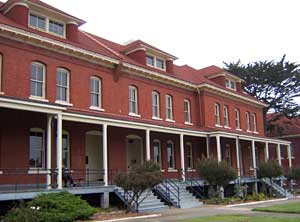
The circa 1890 barracks at San Francisco's Presidio. They had to be very carefully modified and worked around by the Disney Museum's architect to meet the requirements of this historic site

Of course I was happy to be able to help out in any way however small. When dropping my original off I was privileged to be shown an elaborate virtual walkthrough, examples of exhibits, and an overall idea of what the museum would be and look like. I found it utterly exhilarating. Truly worthy of Disney's oft-expressed vision of educating coupled with appeal and fun, it's clearly been based on his own approaches to those goals.

The cover to a Museum book that will be available at its bookstore in October. In addition to the store, there's also a theater, a cafe and an education center as part of the campus.

I won't see it myself until tomorrow at a preview, but if it's anything like the plans it's going to be a standard for this sort of place. Walt Disney's life and career contained experiences so simultaneously relatable and visionary, combining spectacular success with equally numbing failures (from which he managed to recover despite sometimes terrible odds--a point the Museum intends to make clear as part of its presentation) that he easily deserves a permanent educational resource of this kind. It's one his family, in particular his daughter Diane Disney Miller, have worked tirelessly to make happen. It's a shame that it's not located in Los Angeles, but having lived in that city for most of my life I can't say I'm amazed that the project couldn't be realized here. And it does make an excellent excuse to make more trips to the Bay Area if anyone needed one.

Opening day is almost here: October 1st. The Museum has been sending me various materials from its holdings and (I'd imagine) displays, a few of which are illustrated here.

Walt and Diane in Los Feliz in the 30s, a stone's throw from the Hyperion studio

Regardless of Walt's telegram, you just know Roy worried.

Yet another rare piece of visual development from a woman Walt gave a unique opportunity to: Mary Blair


Funny--it doesn't say "Park" anywhere on this billboard

It wasn't all work and no play: Walt learned to ride as my own father did-on a midwestern farm. Years later he used this saddle where I've ridden today: the Santa Ynez Valley. Don't know why the color swatches are there.


I wish I knew who drew this board for "Mary Poppins" so I could attribute it-anyone? Note the aspect ratio

After Friday I'll post my impressions; in the meantime, I'd think that regular readers of this blog--assuming you're still around--will have to start planning that little jaunt to San Francisco now.


The Walt Disney Family Museum
104 Montgomery Street
The Presidio of San Francisco
San Francisco, CA 94129

T 415 345 6800